



Ordalin
Submit a tool

Website-checked tool profile

Mouse-1

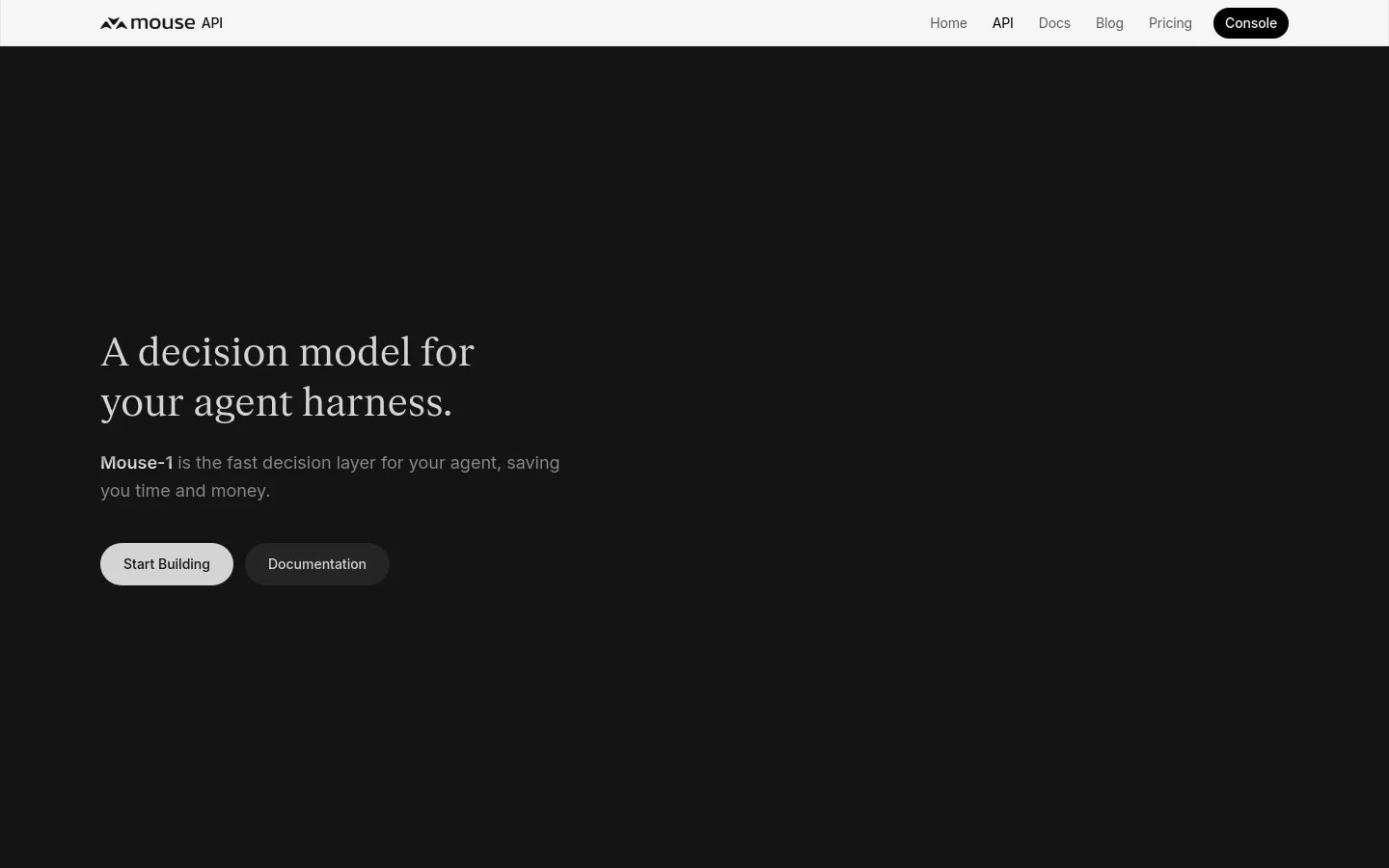
A fast decision model that scores options for agent harnesses instead of generating text.

Sources checked

Visit website ↗
Pricing
Pay-as-you-go API pricing: $0.10 per million input tokens and $0 for output, the same rate for every customer with no seats, tiers or minimums. Usage draws from a prepaid credit balance, and verified accounts get $5 in free starter credits. Optional tuning has its own fees. Official source 1 ↗
Available as
Cloud REST API at api.mouse.dev (US-East) called with a secret API key from TypeScript, Python or agent frameworks such as LangGraph, the Vercel AI SDK and the OpenAI Agents SDK, plus a browser Playground in the Mouse Console. Official source 1 ↗ · Official source 2 ↗ · Official source 3 ↗
Primary group
Coding & Development

Also consider

See all 6 similar tools ↓

What it does

Mouse-1 is a decision model from Mouse, offered through the Mouse API, for agent harnesses and AI-powered software. Instead of generating text, it reads the agent's state and scores up to 128 typed questions in one request (pick an option, a yes/no condition, or a rubric level), returning calibrated probabilities in about 100 ms. The idea is that the harness hands small control-flow decisions, such as which tool to load or whether a shell command is safe to run, to Mouse-1 while the main frontier model does the reasoning and code. Mouse also makes a separate mobile app for cloud coding agents.

Official source 1 ↗ · Official source 2 ↗ · Official source 3 ↗

Features

  • Three question types. Every question is a choice among named options (up to 255), a yes/no condition, or a score on a 2-10 level rubric, and every answer comes back as a schema-valid probability distribution that maps to a switch, an if or a threshold in code. Official source 1 ↗
  • Many questions per request. Up to 128 questions run in parallel against the same state in one call, and the state is billed once, so asking extra questions costs little and never shifts the other answers. Official source 1 ↗
  • Drop-in hooks for coding agents. Mouse documents hook setups for Cursor, Claude Code and OpenCode that auto-approve safe tool calls, block destructive ones with a reason, and fall back to the normal confirmation prompt when confidence is middling. Official source 1 ↗
  • Tool routing and verification. In your own agent loop it can score which tools to load, gate risky actions, check whether test logs back up a 'done' claim, and guard against prompt injection in untrusted text. Official source 1 ↗
  • Calibrated abstention. Fit a calibration profile on 200 or more of your own labeled examples, and each answer then says whether to abstain because confidence is below your target error rate. Official source 1 ↗
  • Image inputs. Requests can include images, such as a screenshot an agent is about to act on, billed as input tokens at the same rate as text. Official source 1 ↗
  • Zero data retention. Request content is processed in memory and discarded, and is not used to train or fine-tune models. Official source 1 ↗ · Official source 2 ↗
  • Tuning on your data. Optional readout and LoRA tunings train on your own examples; a readout tune costs $10 per job and tuned models are hosted for $10 per model per month after the first 30 days. Official source 1 ↗

Pricing & free limits

Mouse API (mouse-1)

$0.10 per 1M input tokensUsage-based, prepaid credits

Output tokens are free; the same rate applies to every customer, with zero data retention included. Official source 1 ↗ · Official source 2 ↗

Tuned inference (shared pool)

$0.40 per 1M input tokensUsage-based

Inference on a model tuned on your own examples; tuning jobs and hosting are billed separately. Official source 1 ↗

Billing details

Spend draws from a prepaid credit balance; at $0.00 the API returns HTTP 402 until you top up or auto-reload runs. Credits are added in amounts from $5 to $500, and auto-reload charges at most once per 24 hours. Official source 1 ↗ · Official source 2 ↗

Requests refused with 4xx validation, authentication or rate-limit errors are not billed. Official source 1 ↗

The Pro ($60/month) and Max ($200/month) plans on Mouse's pricing page are for its separate hosted cloud-agent app, not the mouse-1 API. Official source 1 ↗

Free access & limits

Verified accounts get $5.00 in free starter credits at signup. Official source 1 ↗ · Official source 2 ↗

Best for & limitations

Auto-approving safe shell commands and blocking destructive ones in Cursor, Claude Code or OpenCode without editing prompts. Official source 1 ↗

Choosing which of many MCP tools or skills to load before calling the main model, to cut its input tokens. Official source 1 ↗

Classifying images or documents, such as content moderation, document routing, or reading what state a browser screen is in. Official source 1 ↗
  • Decisions only, no text output. Mouse-1 only picks among the options you define and never generates text, so it complements a frontier model rather than replacing one. Official source 1 ↗ · Official source 2 ↗
  • Single US-East region and preview snapshot. The API is served from US-East only, and the current model snapshot is named mouse-preview-2026-10-13. Official source 1 ↗
  • Server-side keys and rate limits. Standard keys allow 10 requests per second (burst 20) and 1M tokens per minute, and cannot be used from browser code. Official source 1 ↗
  • Image support is in beta. Image URLs, multipart uploads and video are not supported, and tunings accept text examples only. Official source 1 ↗
  • Benchmarks are Mouse's own. The accuracy and prompt-injection results on the site come from Mouse's own tests. Official source 1 ↗
Mouse-1 product screenshot
Website previewFixed desktop viewport · 1440 × 900

Similar tools

Published tools that share its categories.