What it does
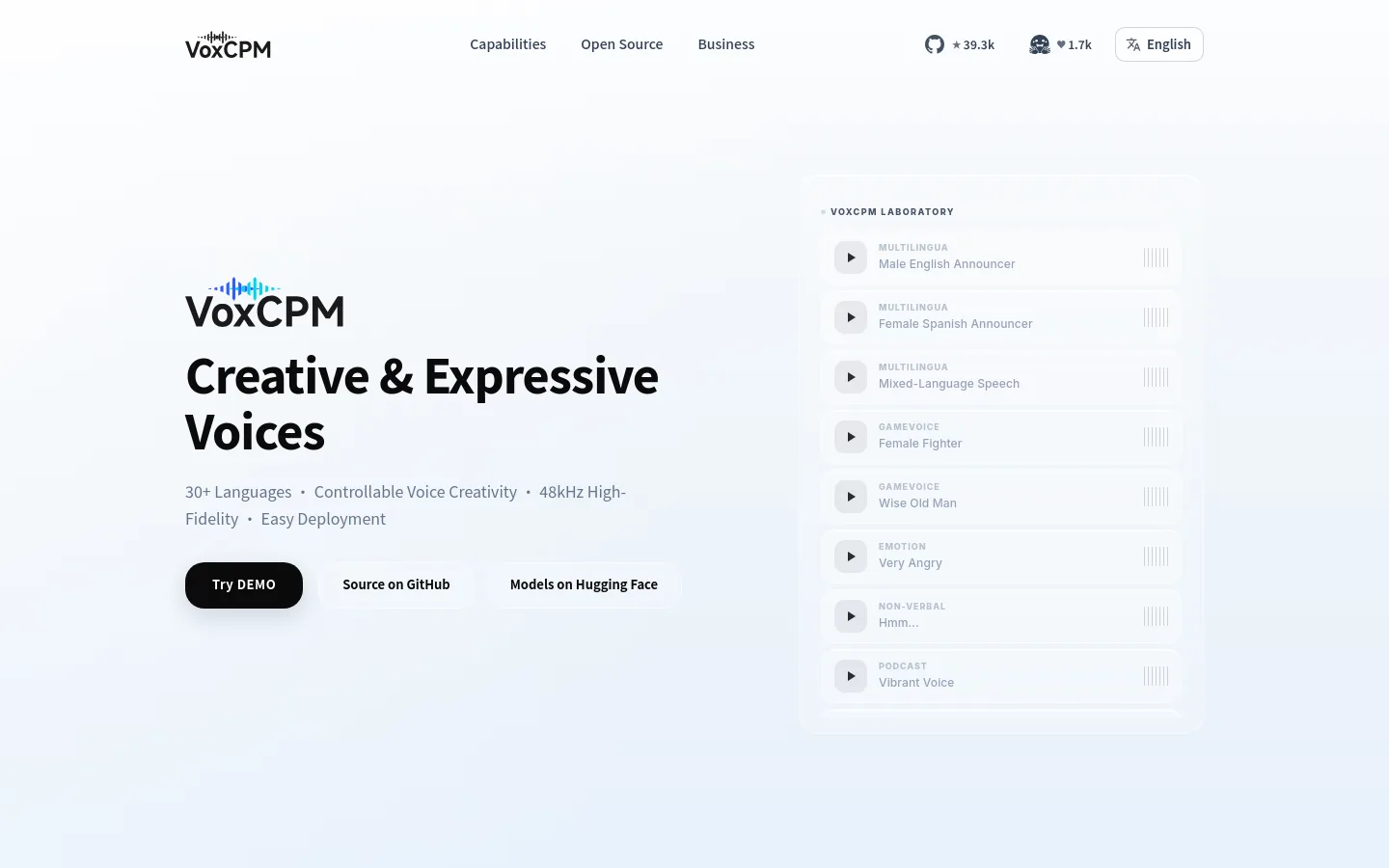
VoxCPM is an open-source text-to-speech system from OpenBMB. Its latest release, VoxCPM2, is a 2B-parameter model trained on over 2 million hours of multilingual speech, with 30 languages, voice design, controllable voice cloning and 48kHz output. It is used as a Python library, CLI or local web demo rather than a hosted app.
Official source 1 ↗ · Official source 2 ↗Features
- 30 languages without language tags. Type text in any of 30 supported languages and synthesize it directly, with no language tag. Chinese dialects such as Cantonese, Sichuanese and Wu are also listed. Official source 1 ↗
- Voice design from a text description. Create a new voice by describing gender, age, tone, emotion or pace in parentheses before the text, with no reference audio. Instructions can be written in Chinese or English. Official source 1 ↗ · Official source 2 ↗
- Controllable voice cloning. Clone a voice from a short reference clip without a transcript, then steer emotion, pace and expression while keeping the original timbre. Official source 1 ↗ · Official source 2 ↗
- Hi-fi cloning with a transcript. For the closest match, supply the reference audio and its exact transcript; the model continues from the reference to preserve timbre, rhythm, emotion and style. Official source 1 ↗
- 48kHz output from 16kHz references. Accepts 16kHz reference audio and outputs 48kHz audio with built-in super-resolution, so no separate upsampler is needed. Official source 1 ↗
- Streaming and high-throughput serving. A streaming API returns audio in chunks. Real-time factor is about 0.3 on an RTX 4090, or about 0.13 with Nano-vLLM or vLLM-Omni serving. Official source 1 ↗
- LoRA and full fine-tuning. Fine-tune on your own voices with LoRA or full fine-tuning from as little as 5–10 minutes of audio. LoRA on VoxCPM2 needs roughly 20 GB of VRAM and full fine-tuning roughly 40 GB. Official source 1 ↗ · Official source 2 ↗
- Text normalization and phoneme control. Optional text normalization expands numbers and dates; for exact pronunciation you can pass pinyin with tone numbers or CMUDict-style phonemes. Official source 1 ↗
Pricing & free limits
Billing details
Billing details were not established by the checked official sources.
Free access & limits
Free access and its limits were not established by the checked official sources.
Best for & limitations
Narrate audiobooks with expressive intonation and natural rhythm. Official source 1 ↗
Give game NPCs distinct character voices with emotional range. Official source 1 ↗
Produce speech that switches between languages while keeping one stable voice. Official source 1 ↗
Serve TTS behind an OpenAI-compatible speech endpoint in your own application. Official source 1 ↗
- Results vary between runs. Voice design and style control are not deterministic; the team recommends generating one to three times to get the wanted result. Official source 1 ↗
- Uneven quality across languages and long inputs. Quality depends on how much training data a language had, and very long or highly expressive inputs can be unstable. Official source 1 ↗
- Needs testing before production. Commercial use is allowed, but the team does not recommend production use without rigorous testing and safety evaluation. Official source 1 ↗
- Setup is developer-level. There is no hosted app on the official site: you install Python dependencies yourself, and Windows users can hit Triton and torch.compile errors that need workarounds. Official source 1 ↗ · Official source 2 ↗
- Voice cloning misuse rules. Using it for impersonation, fraud or disinformation is forbidden, and generated content should be labelled as AI-generated. Official source 1 ↗

 Submit a tool