What it does
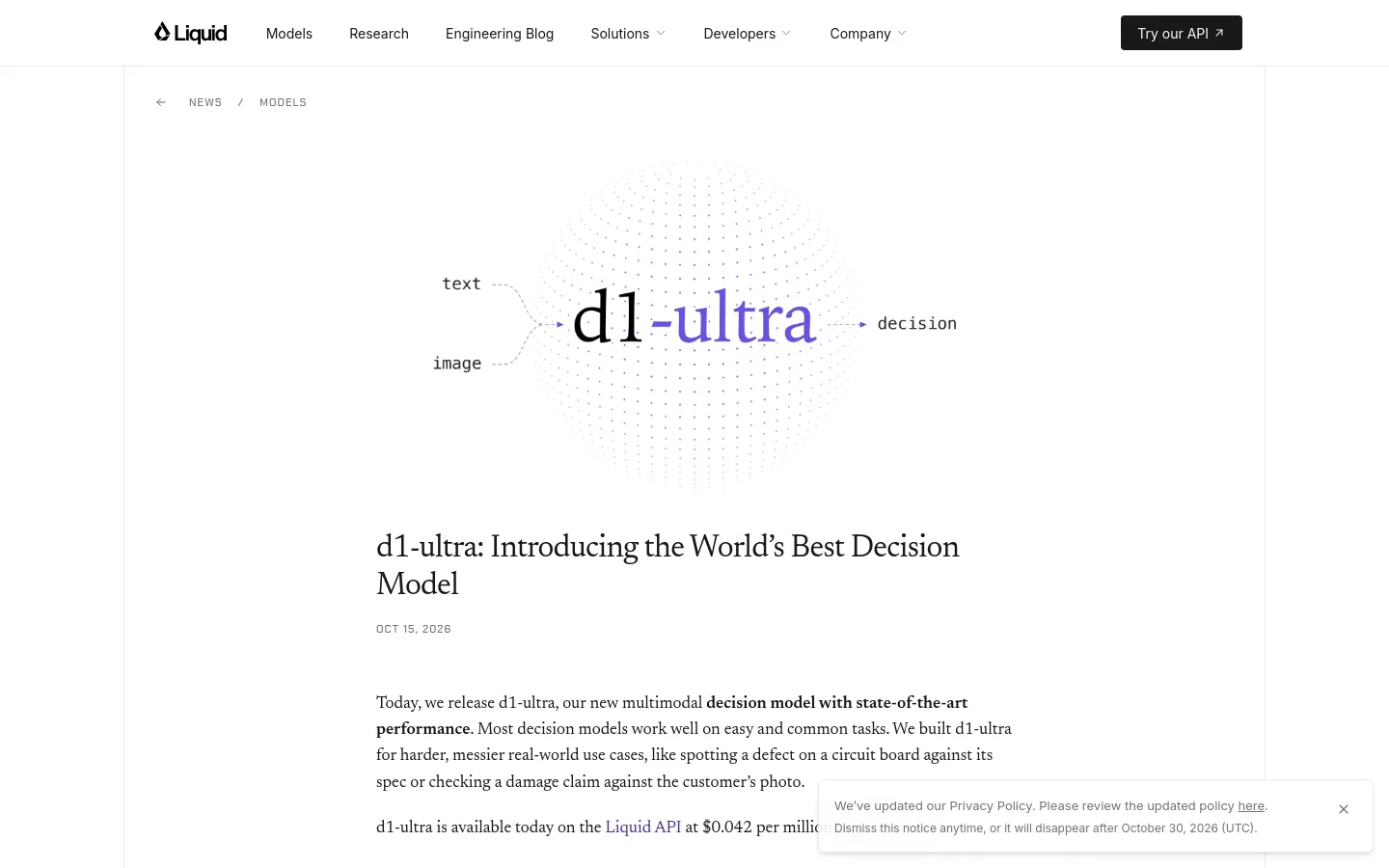
d1-ultra is Liquid AI's most capable decision model, released on 15 October 2026. Instead of generating text, it reads text, images or both together with one or more questions and returns a probability for each possible answer in a single forward pass. Liquid built it for harder real-world decisions such as checking a circuit board against its spec or a damage claim against the customer's photo, and offers it as a hosted model on the Liquid API.
Official source 1 ↗ · Official source 2 ↗Features
- Probabilities instead of generated text. Answers each question with a probability for every possible answer, in one forward pass and without generating tokens. Official source 1 ↗
- Text and image input. Reads text, images or both at once, so a decision can be based on a photo or screenshot as well as written context. Official source 1 ↗ · Official source 2 ↗
- Three question types: noul, choice and score. Supports yes/no questions answered with a probability from 0 to 1 (noul), one label from many with a probability per label (choice), and a position on an ordered scale (score). Official source 1 ↗
- Several questions per request. One request can carry several questions about the same input; each question is billed as its own prompt. Official source 1 ↗
- Trained for calibration. Liquid says most decision models are overconfident, so it trained d1-ultra specifically to produce more reliable probabilities. Official source 1 ↗
- Larger base than d1. Built on a larger open-weight model than d1 with Liquid-specific customisations; in Liquid's own comparison across 112 evaluations it beat d1 and Jev 1.14, and Liquid reports it leads other decision models on the Artificial Analysis Decision Index by at least 8 points. Official source 1 ↗
Pricing & free limits
Only input tokens are billed; images count as input tokens at the text rate. New organizations get $2 in free credit on Liquid Console. Smaller d1 costs $0.02 per million input tokens. Official source 1 ↗ · Official source 2 ↗
Billing details
Billing is on input tokens only. Images are charged as input tokens at the text rate (1.5 tokens per 32×32-pixel patch, so a 1024×1024 image is 1,536 tokens), and each question is billed as its own prompt including its text and all images. Official source 1 ↗
Liquid says the price is the same wherever you call its models from, with each platform handling its own payment and invoicing. Official source 1 ↗
Free access & limits
Every new organization gets $2 in free credit on Liquid Console. Official source 1 ↗
Best for & limitations
Visual quality inspection: asking whether a product image shows a defect, such as checking a circuit board on a production line against its spec. Official source 1 ↗ · Official source 2 ↗
Classification and routing: intent detection, ticket routing, content moderation and triage with a probability on each outcome. Official source 1 ↗
Scoring and gates: urgency or quality scoring as an LLM-as-judge replacement, and yes/no safety checks, guardrails or agent tool-call approval. Official source 1 ↗
- Not for generating text. Liquid says to use a language model instead for free-form text, conversation, complex multi-step reasoning, open-ended Q&A, summarisation and code generation. Official source 1 ↗
- Hosted only, no audio. d1-ultra is a hosted API model for text and images; audio input is only listed for the smaller d1-omni-600M. Official source 1 ↗