What it does
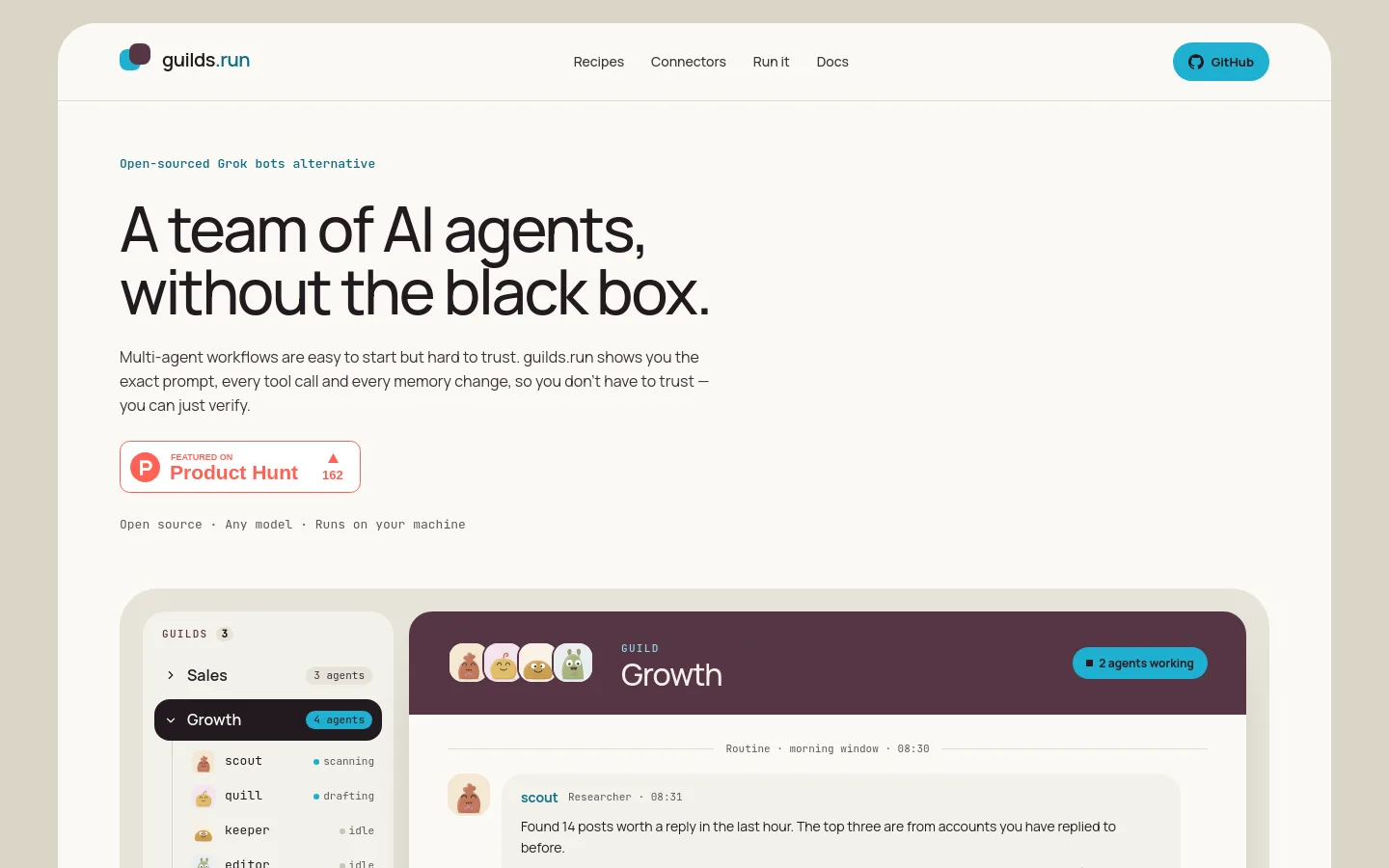
guilds.run is an open-source framework for running standing teams of AI agents on your own machine. A team (a guild) has named agent roles, a shared group chat, shared tables and schedules, and every run keeps the exact prompt the model saw, every tool call and every memory change so you can see why something went wrong. Each agent can use a different model, from Claude and GPT to open-weight models through your own keys. It is made by Cigale AI; a hosted edition is announced but not yet available.
Official source 1 ↗ · Official source 2 ↗Features
- Full run inspection. Every run records the exact prompt, each tool call with its result, every memory change and who wrote each note, so you can trace which agent and step caused a bad result. Official source 1 ↗
- Agent teams with group chat. A guild holds several agents with their own roles and focus, a shared group chat where agents and you can tag each other, and up to 15 agents by default. Official source 1 ↗
- Routines and schedules. Agents wake on a cron schedule or at random times inside a daily window, so a team can keep working without you starting each run. Official source 1 ↗
- Prompt Studio coach. A built-in coach reads a live guild's runs, notes and memory, finds why something keeps going wrong and drafts changes to an agent's standing task. Nothing changes until you review and publish the draft. Official source 1 ↗
- Shared notes, tables and scripts. Agents keep notes, memory, structured tables and reusable scripts that you can open and edit; every change is versioned with its author and run step. Official source 1 ↗
- Any model per agent. Mix Claude, GPT, Gemini, Grok and open-weight models such as Qwen, DeepSeek and Llama in one team, through OpenRouter, DeepInfra, a local Ollama endpoint or your own keys. Official source 1 ↗
- Sandboxed agent computers. Each agent gets its own container with a terminal, a persistent workspace, an optional logged-in browser and coding tools, and you can watch it work live. Official source 1 ↗
- Connectors with scoped access. Connect accounts such as Notion, Gmail, Google Drive, GitHub and Sentry for the whole organisation, one guild or one agent; a run only offers the tools you turned on. Official source 1 ↗
- Recipes. A recipe captures a whole team (roles, tasks, tables, schedules and scripts) in one portable file you can export, share and apply; credentials and memory are never included. Official source 1 ↗ · Official source 2 ↗
Pricing & free limits
Billing details
There is no subscription for the open-source core; costs come from the model providers whose keys you add. Platform keys for the hosted edition are announced as coming soon. Official source 1 ↗
Free access & limits
Free access and its limits were not established by the checked official sources.
Best for & limitations
Running a social growth team that finds posts worth replying to, drafts replies in your voice and keeps a queue for approval. Official source 1 ↗
Sales prospecting: researching accounts, drafting outreach and tracking every thread. Official source 1 ↗
Support triage that reads an inbox, tags and routes messages and drafts first replies for review. Official source 1 ↗
Open-source maintenance: triaging GitHub issues, reviewing pull requests and moving the backlog. Official source 1 ↗
- Self-hosting required for now. You need Docker with Compose, git and bash, and the first image build takes several minutes; the hosted edition is not available yet. Official source 1 ↗
- No built-in authentication by default. Out of the box the stack does not authenticate: anyone who can reach the port acts as the operator, so remote access needs extra setup. Official source 1 ↗
- Recipe directory not live yet. The public directory of ready-made team recipes is announced as coming soon. Official source 1 ↗
- Developer-oriented setup. Configuring agents, grants, connectors and recipes is documented at a technical level, which suits technical operators more than non-technical teams. Official source 1 ↗