What it does
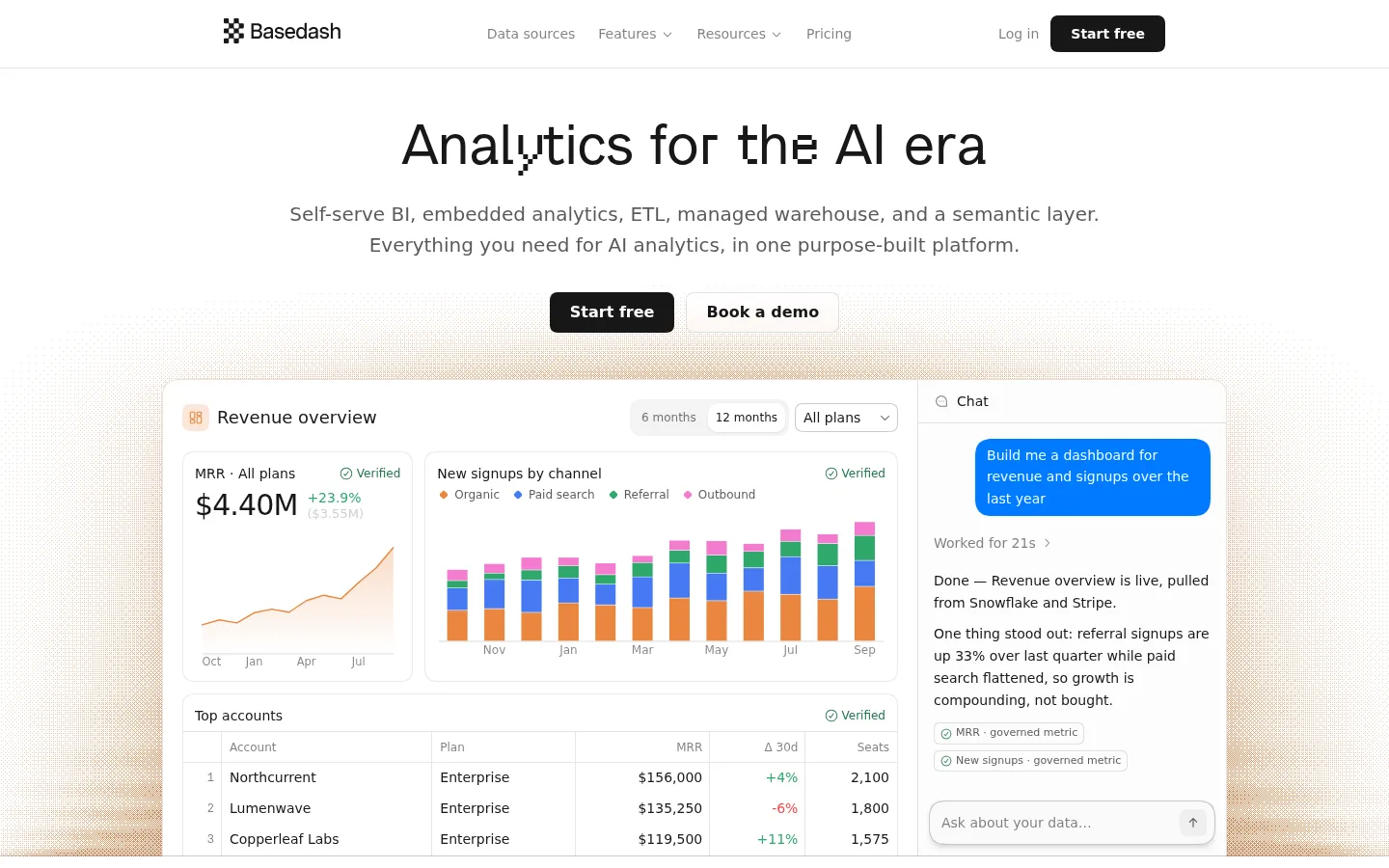
Basedash is an AI business-intelligence platform from Basedash Inc. You connect databases, warehouses and SaaS tools, ask questions in plain English, and it writes and runs the SQL, then returns an answer, chart or dashboard with the query shown. It also includes a managed warehouse, data ingestion from 750+ sources, a semantic layer for shared metric definitions, anomaly alerts, embedded analytics and an MCP server. It is priced for teams: the Startup plan is $1,000 a month plus AI usage.
Official source 1 ↗ · Official source 2 ↗ · Official source 3 ↗ · Official source 4 ↗Features
- Plain-English questions with the SQL shown. Anyone on the team can ask a question and get a chart, a dashboard or a direct answer; every result shows the SQL it ran. Official source 1 ↗ · Official source 2 ↗
- Governed metric definitions. Answers use the metric definitions your data team has set; when none exists, Basedash says which definition it chose and names the main alternative. Metrics can be defined in models or pulled from existing dbt projects. Official source 1 ↗ · Official source 2 ↗
- Dashboards that refresh themselves. A useful answer can be added to a dashboard, where it keeps refreshing with the same SQL. Official source 1 ↗
- Anomaly alerts and scheduled reports. Agents watch metrics, flag what changed and why, and post a summary to Slack or email, on a schedule or when data changes. Official source 1 ↗
- Embedded analytics for your product. Embed dashboards and AI chat in your own app with React components, white-label them and scope each customer to their own rows with JWT SSO. Official source 1 ↗
- Managed warehouse and 750+ data sources. Includes the Basedash Warehouse and syncing from 750+ data sources on the Startup plan. Official source 1 ↗
- Access controls and bring-your-own AI keys. Answers follow role-based access and row-level security, and you can use your own OpenAI, Anthropic, Azure or Bedrock keys. Official source 1 ↗
Pricing & free limits
Up to 25 users, 750+ data sources, $1,000 of AI credits a month, the Basedash Warehouse, automations, insights, the Slack app, the MCP server and Slack support. Starts with a 14-day free trial. Official source 1 ↗
Custom seats, $1,000 of AI credits a month, self-hosting, embedding, SSO, SCIM, audit logs, custom AI models and dedicated support. Official source 1 ↗ · Official source 2 ↗
Billing details
AI work such as chat answers, chart and dashboard generation, automations and insights draws from the monthly AI credits; overage is billed in arrears on the next invoice unless an admin turns on-demand usage off. Official source 1 ↗ · Official source 2 ↗
Admins can set an organization spend limit and per-member spend limits on AI usage beyond the included credits. Official source 1 ↗
Unused AI credits do not roll over; they reset each billing period. Opening dashboards, running saved chart queries and editing SQL by hand do not use credits. Official source 1 ↗
Self-hosting, non-profit discounts and enterprise procurement are available through sales. Official source 1 ↗
Free access & limits
There is no free plan. The 14-day free trial has full feature access, needs no credit card and includes up to $250 of AI usage at no charge. Official source 1 ↗ · Official source 2 ↗
Best for & limitations
Startup and operations teams answering revenue, churn and signup questions without waiting on a data analyst. Official source 1 ↗
SaaS companies adding customer-facing dashboards and AI chat to their own product. Official source 1 ↗
Asking questions about company data from Slack, Claude, ChatGPT or Cursor through the same definitions and permissions. Official source 1 ↗
Security-conscious companies that need SOC 2 Type II, SSO, SCIM, audit logs and self-hosted or VPC deployment. Official source 1 ↗
- No free plan and a high entry price. The cheapest plan is $1,000 a month plus AI usage, so it is aimed at teams rather than individuals. Official source 1 ↗
- AI overage is billed by default. On-demand usage beyond the included credits is on by default; set a spend limit if you need a hard cap. Official source 1 ↗
- Enterprise-only controls. SSO, SCIM, audit logs, self-hosting, embedding and custom AI models are listed only on the custom-priced Enterprise plan. Official source 1 ↗
- HIPAA and GDPR need a VPC or self-hosted deployment. Basedash says HIPAA and GDPR needs are supported through private VPC and self-hosted deployments. Official source 1 ↗
- Accuracy figure is self-benchmarked. Basedash cites 94.8% accuracy on hard questions from BI Bench, a benchmark it runs and publishes itself; we have not checked it independently. Official source 1 ↗