What it does
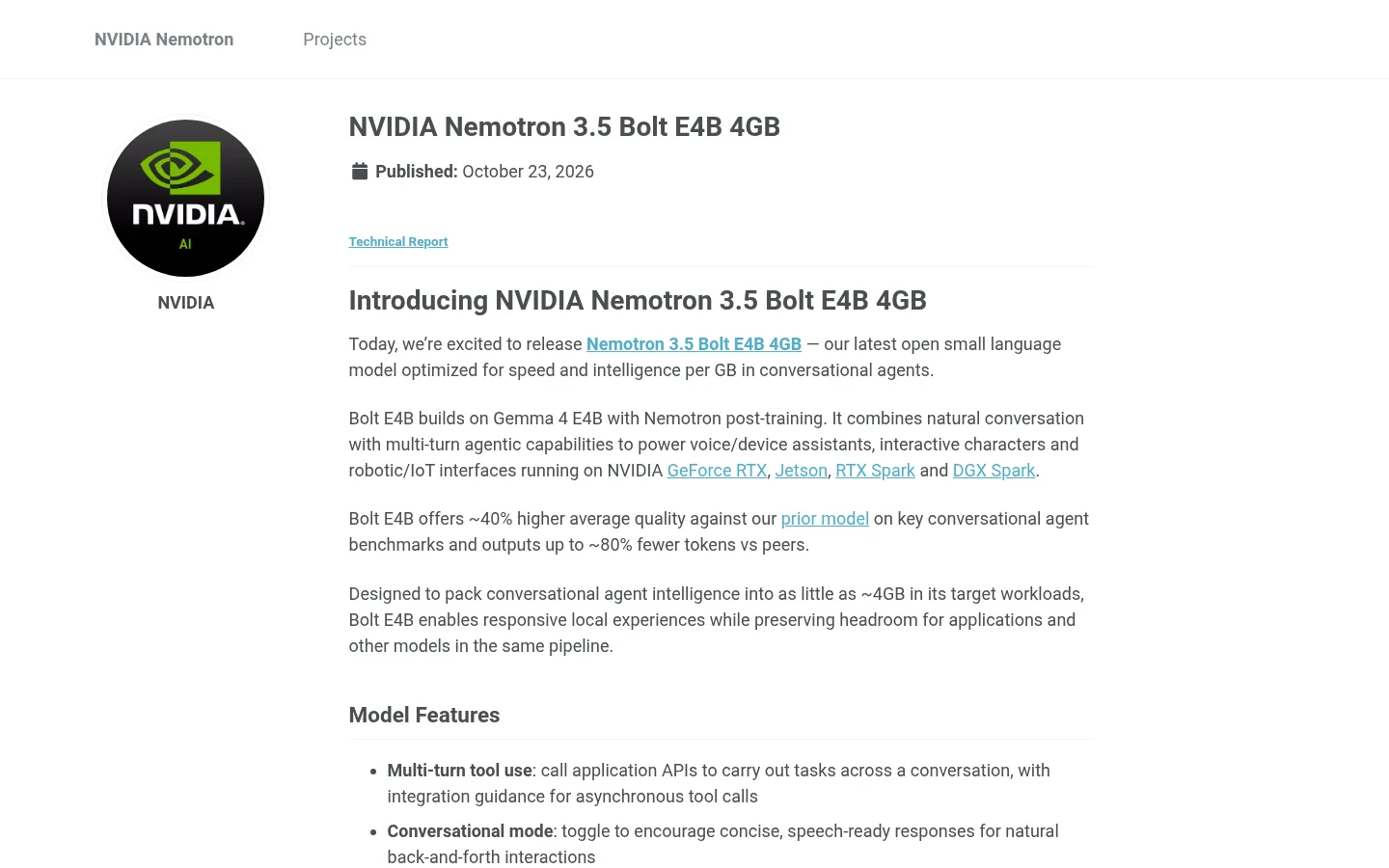
Nemotron 3.5 Bolt E4B 4GB is an open small language model from NVIDIA, published on 23 October 2026. NVIDIA post-trained Google's Gemma 4 E4B (8B parameters, 4B effective) for conversational agents that talk naturally and call tools across many turns: voice and device assistants, game characters, and robot or IoT interfaces. It is text in, text out, and is designed to run locally in about 4 GB on NVIDIA GeForce RTX, Jetson, RTX Spark and DGX Spark hardware.
Official source 1 ↗ · Official source 2 ↗Features
- Multi-turn tool use. The model calls application APIs to carry out tasks over a conversation. The model card explains how to handle asynchronous tool calls whose results arrive later. Official source 1 ↗ · Official source 2 ↗
- Conversational mode for spoken replies. A switch makes answers short and lightly formatted, suited to voice and back-and-forth chat. It works with reasoning on or off and with tool calling. Official source 1 ↗ · Official source 2 ↗
- Reasoning on, off or on a budget. Reasoning (thinking) is on by default. You can turn it off for faster direct answers, or cap the thinking tokens at runtime, for example with llama-server's --reasoning-budget, to meet a latency target. Official source 1 ↗ · Official source 2 ↗
- 64K context and 35 languages. A 64K-token context holds conversation history, instructions, tool definitions, retrieved data and app state. NVIDIA lists support for 35 languages; the base model was pre-trained on more than 140. Official source 1 ↗
- Small memory footprint with published speeds. The 4-bit Q4_K_M build targets about 4 GB. In NVIDIA's llama.cpp tests at batch size 1 with a 3K-token prompt, it used 3.5 GB of VRAM on an RTX 5070, with a first token in 548 ms and 133 tokens per second. Official source 1 ↗
- DFlash drafter for faster generation. A companion DFlash drafter model is released for speculative decoding. NVIDIA reports up to 21% higher throughput than Gemma 4 E4B's original MTP drafter. Official source 1 ↗
- Shorter answers and NVIDIA-reported gains. On NVIDIA's own benchmark set, Bolt E4B scores about 40% higher on average than its prior Nemotron 3 Nano 4B and about 10% higher than the other peers tested, while producing up to 80% fewer output tokens with reasoning enabled. Official source 1 ↗
- Open training recipe and datasets. NVIDIA publishes the training datasets and the full post-training recipe (reinforcement learning with NeMo RL and NeMo Gym), in line with Nemotron's open weights, data and recipes. Official source 1 ↗ · Official source 2 ↗
Pricing & free limits
Download the 4-bit GGUF build, the DFlash drafter or the BF16 checkpoint from Hugging Face and run them on your own hardware. NVIDIA says the model is ready for commercial or non-commercial use. The Gemma 4 base model it was post-trained from is under Apache 2.0. Official source 1 ↗ · Official source 2 ↗
NVIDIA hosts a free endpoint you can call with an API key. No partner endpoint is listed. The page does not state usage limits or a paid hosted price. Official source 1 ↗
Billing details
Billing details were not established by the checked official sources.
Free access & limits
Free access and its limits were not established by the checked official sources.
Best for & limitations
Fast local device and voice assistants: controlling a PC, phone, app, home or operating system, answering customer service questions, or running an in-car assistant. Official source 1 ↗
Game characters that stay in persona and take actions. NVIDIA's demo is a blacksmith trader NPC that checks payment, then calls tools to look up a recipe, gather ingredients, craft the item and hand it over. Official source 1 ↗
Robot and industrial interfaces. In NVIDIA's demo a Reachy Mini robot on a Jetson Orin Nano 8GB pairs Bolt E4B with Cosmos 3 Edge for vision; Bolt E4B speaks and triggers the robot's animation scripts. Official source 1 ↗
- Text only. Input and output are text only. Voice or vision features need separate models in your pipeline, as in NVIDIA's robot demo. Official source 1 ↗
- Behind Qwen 3.5 4B on some agent and long-context tests. In NVIDIA's own tables, Bolt E4B scores 55.1 on Tau2-Bench multi-turn customer tasks against 75.1 for Qwen 3.5 4B, and 50.5 against 59.9 on LongBench v2 (48K). Official source 1 ↗
- Vendor-run benchmarks. Benchmark scores are measured by NVIDIA and may differ from other vendors' numbers. Two of the benchmarks NVIDIA uses, Brevity Bench and When2Call-MT, have not been released yet. Official source 1 ↗ · Official source 2 ↗
- Slow on the smallest Jetson. On a Jetson Orin Nano 8GB, NVIDIA measured 5.8 seconds to the first token and 15.5 tokens per second for a 3K-token prompt, and up to 5 GB of memory on Jetson with a 32K cached context. Official source 1 ↗
- Integration caveats. The chat template rejects tool results that do not directly follow the assistant's tool call, so asynchronous results need NVIDIA's acknowledge-then-report workaround. Tight thinking budgets can cut reasoning off mid-sentence. Official source 1 ↗