What it does
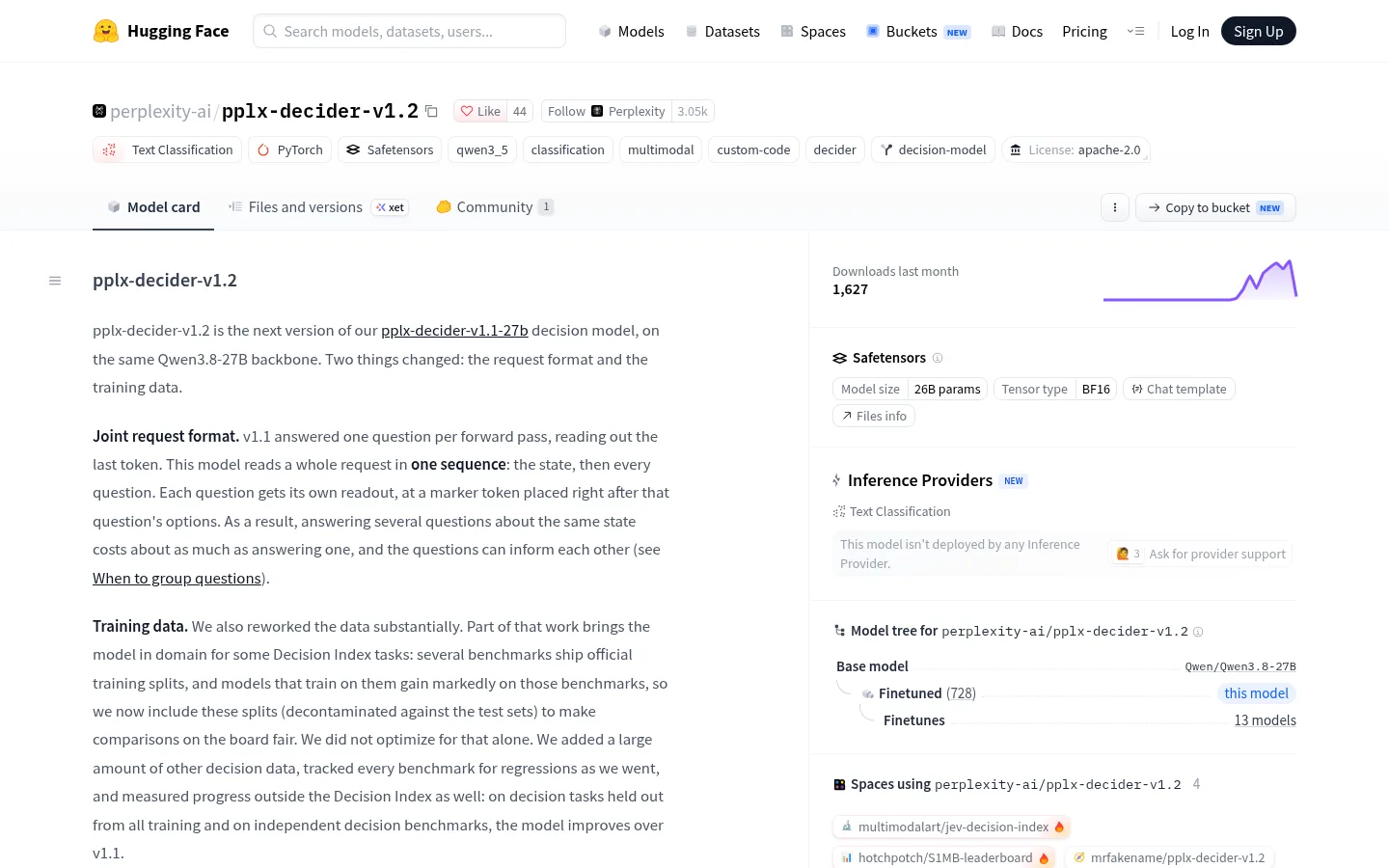
Perplexity Decider (pplx-decider) is a family of open-weight decision models from Perplexity. Instead of writing text, it answers structured questions about a piece of text or an image: it picks one of up to 255 options, gives a yes/no probability or places the input on a scale, with a probability for each answer. Developers use it to route requests, label content and rerank search results. The current release, v1.2, comes as a 27B model built on Qwen3.8-27B, a smaller Flash model built on Qwen3.5-4B, and a GGUF build of Flash for llama.cpp-style runtimes. All are Apache 2.0.
Official source 1 ↗ · Official source 2 ↗ · Official source 3 ↗Features
- Three question types. A choice question picks among 1 to 255 named options, a yes/no question returns the probability of true, and a score question places the input on a scale (2 to 255 levels with the open weights, up to 10 on the hosted API). Every answer comes with probabilities and a confidence value rather than generated text. Official source 1 ↗ · Official source 2 ↗
- Several questions in one pass. The 27B model reads the input once and answers every question about it in the same pass, so asking several related questions costs about as much as asking one. Perplexity advises grouping related questions and scoring independent candidates separately; Flash should get one question per request. Official source 1 ↗ · Official source 2 ↗
- Text and images. Both the 27B and Flash models accept images alongside text, resized to at most 1.6 megapixels, and every question can see them. Official source 1 ↗ · Official source 2 ↗
- Calibrated probabilities. A temperature fitted on held-out data is applied to the probabilities. On Perplexity's development set of 1,497 questions it reports 91.3% accuracy with an expected calibration error of 0.014. Official source 1 ↗
- Reranking. Yes/no questions can score (query, document) pairs for search reranking; Perplexity recommends the logit margin because it avoids ties. Official source 1 ↗
- Fast path for batches. An optional fast mode packs many requests per forward pass and compiles the model. Perplexity reports a single request answered in 96 ms (median) on one GB200, against 131 ms for the reference path. Official source 1 ↗
- Small Flash model. Flash is distilled from the 27B models at about one seventh of the size, for when latency or cost matters more than the last points of accuracy. Official source 1 ↗
Pricing & free limits
Download pplx-decider-v1.2 (27B), pplx-decider-flash-v1.2 or the Flash GGUF build from Perplexity's Hugging Face page and run it on your own hardware under the Apache 2.0 license. Official source 1 ↗ · Official source 2 ↗ · Official source 3 ↗
Menu-bar app that runs pplx-decider-flash-v1.2 on an Apple silicon Mac and serves the same Decisions API locally, with no usage bill. Official source 1 ↗
Hosted API for pplx-decider-v1.2 and pplx-decider-flash-v1.2. You pay for input tokens only; output tokens are free and there is no per-request fee. A 600-token request costs $0.000012 on the 27B model. Official source 1 ↗
Billing details
Hosted API requests are billed on input tokens only: the content, every question and any images count, and each response reports the exact input token count. Official source 1 ↗
Free access & limits
The hosted API allows 10 requests per second per organisation by default, shared across both models; Decider for Mac and self-hosted weights have no usage bill. Official source 1 ↗ · Official source 2 ↗
Best for & limitations
Routing support requests: Perplexity's example sends a message to the billing, support or sales team, flags whether the customer is blocked and rates their frustration in one request. Official source 1 ↗
Multi-label tagging and routing decisions inside agent pipelines, such as several attributes of the same item or the steps of a routing decision. Official source 1 ↗
Reranking retrieved documents for search, one (query, document) pair per request. Official source 1 ↗
- Not a chat model. Decider only chooses among the options you provide and returns probabilities. It does not generate text answers. Official source 1 ↗
- Self-hosting needs a CUDA GPU. The Python package needs a CUDA GPU; the 27B model needs room for about 52 GiB of weights. Without one, use Decider for Mac (Flash only, Apple silicon) or the hosted API. Official source 1 ↗ · Official source 2 ↗
- Mac app runs Flash only. Decider for Mac runs a q8_0 GGUF build of Flash, not the hosted deployment, so Perplexity suggests re-checking thresholds against the hosted model. It may ask for a Hugging Face token to download the model. Official source 1 ↗
- Validated up to about 32K tokens. Training used sequences of about 32K tokens. Longer inputs run but are only spot-checked, and Perplexity suggests validating them on your own task. Official source 1 ↗
- Some over-confidence on new tasks. On decision datasets held out from training, Perplexity says the probabilities remain somewhat over-confident. Official source 1 ↗
- Vendor-run benchmarks. Scores come from Perplexity's own Decision Index suite, and v1.2 was trained on official training splits of some of its benchmarks. Official source 1 ↗