What it does
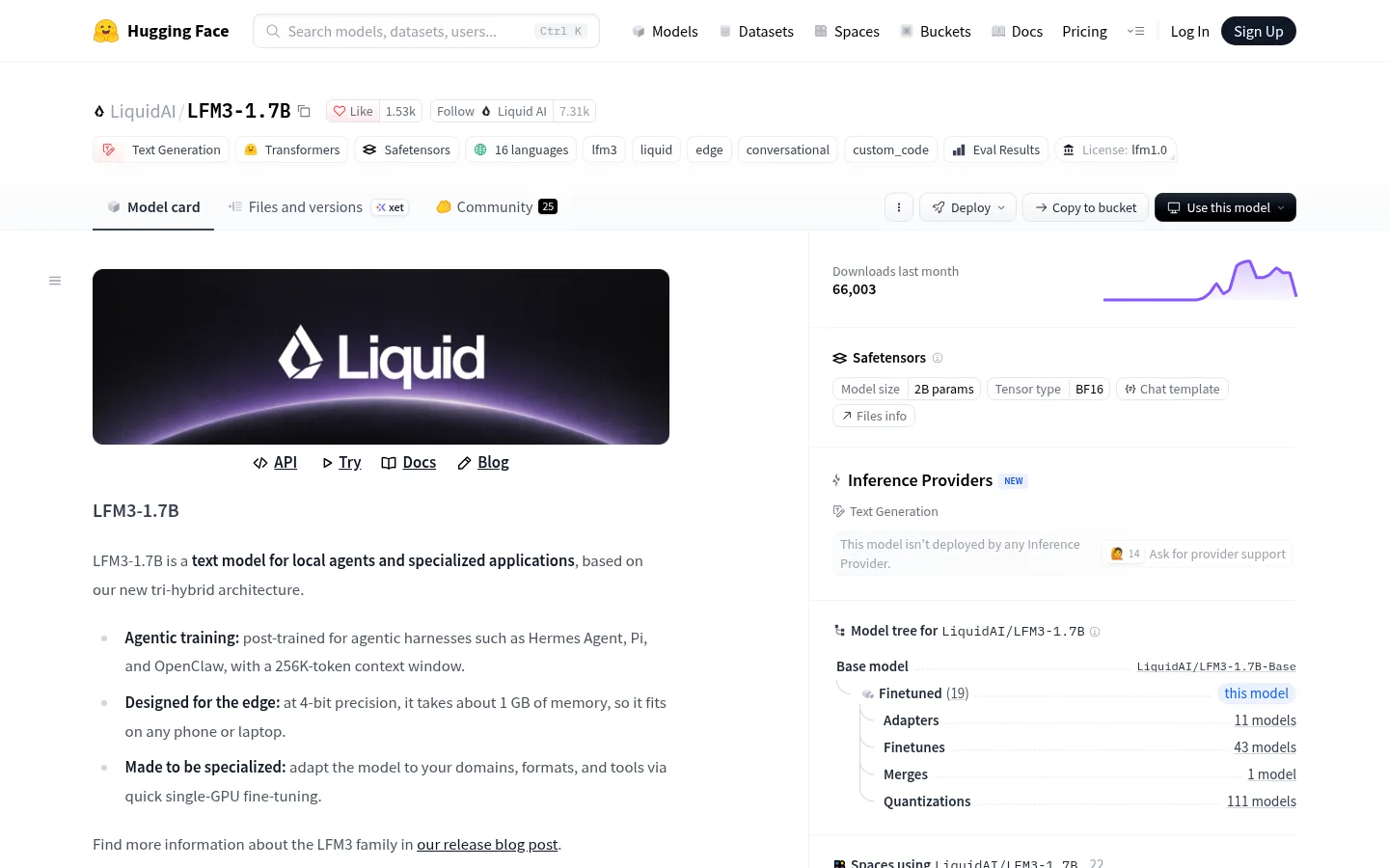
LFM3-1.7B is the text model in Liquid AI's LFM3 family, released on 27 October 2026. It has 1.73B parameters, a 256K-token context and a hybrid architecture of short convolutions and attention, and it is post-trained to run inside agent harnesses such as Hermes Agent, Pi and OpenClaw. At 4-bit precision it needs about 1 GB of memory, so it runs on a phone or laptop. The weights are on Hugging Face under the LFM Open License, and the model is also served by the Liquid API, OpenRouter and Vercel AI Gateway. It is text-only; the sibling LFM3-Omni-2B handles images, video and speech.
Official source 1 ↗ · Official source 2 ↗Features
- Built for local agents. Post-trained inside real agent harnesses for jobs like inbox triage, calendar management, web research and scheduled briefings, with a 256K-token context. Official source 1 ↗ · Official source 2 ↗
- Tool calling and tool search. Function schemas go through the chat template, and deferred tools keep large tool catalogues out of the prompt until the harness's search tool finds the one it needs. Official source 1 ↗ · Official source 2 ↗
- Fits on a phone. About 1 GB of memory at 4-bit. Liquid reports it prefills at least 2.5x and decodes at least 1.8x faster than every compared model on its three test devices, and a full 128K context needs 1.6 GB of KV cache. Official source 1 ↗ · Official source 2 ↗
- Reasoning on by default. The model thinks before answering by default; thinking can be switched off, though Liquid says that can be inconsistent on reasoning-heavy tasks. Official source 1 ↗
- Single-GPU fine-tuning. Liquid publishes TRL notebooks for SFT, DPO, GRPO and continued pre-training, from JSON extraction to calling the right tool in a 108-tool phone app. Official source 1 ↗
- Agent benchmarks above its size. In Liquid's table it scores 71.39 on BFCL V4 and 38.42 on WebArena-Verified, ahead of Qwen3.5-9B on both. In a MacPaw test on 65 macOS agent tasks it reached 64% success against 48% for Qwen3.5-2B. Official source 1 ↗ · Official source 2 ↗
Pricing & free limits
Free for developers, researchers, non-profits and businesses with under $10M annual revenue, including production use. Fine-tunes stay yours. Official source 1 ↗ · Official source 2 ↗
Required for businesses with more than $10M in annual revenue that use the open weights in production. Official source 1 ↗
Cached input $0.02 per 1M tokens. New organizations get $2 in free credit. Official source 1 ↗
Billing details
The API price is the same on Liquid Console, OpenRouter and Vercel AI Gateway; each platform bills you itself. Official source 1 ↗
Free access & limits
Every new Liquid Console organization gets $2 in free API credit. Official source 1 ↗
Best for & limitations
Running a personal assistant agent on your own laptop or phone that triages email, manages a calendar and sends briefings. Official source 1 ↗ · Official source 2 ↗
High-volume background agents and real-time classification where token cost matters, such as many agents running in parallel. Official source 1 ↗ · Official source 2 ↗
Fine-tuning a small specialist model for structured extraction, grounded answers or a fixed tool set. Official source 1 ↗
Desktop agents on the Mac that need a small model to finish everyday tasks. Official source 1 ↗
- Not open source in the OSI sense. The LFM Open License is based on Apache 2.0, but free commercial use ends once your company's annual revenue passes $10 million, and redistribution must keep Liquid's notices. Official source 1 ↗
- Weak at agentic coding and knowledge. Liquid does not recommend it for agentic coding or complex multi-step reasoning, and suggests retrieval or search for knowledge-heavy tasks. It trails Qwen3.5-9B on SWE-bench Verified, GPQA Diamond and RULER 128K. Official source 1 ↗ · Official source 2 ↗
- Text only. It reads and writes text only; images, video and speech need LFM3-Omni-2B or the other LFM3 models. Official source 1 ↗
- Thinking toggle is unreliable. Turning reasoning off can behave inconsistently, especially on reasoning-heavy tasks. Official source 1 ↗
- Vendor-reported scores. The benchmarks and speed figures come from Liquid AI's own runs, and the macOS comparison from a partner quote in Liquid's launch post. Official source 1 ↗ · Official source 2 ↗
- 16 languages. Supported languages are English, Arabic, Chinese, French, German, Italian, Japanese, Korean, Portuguese, Spanish, Vietnamese, Thai, Indonesian, Hindi, Russian and Polish. Official source 1 ↗