What it does
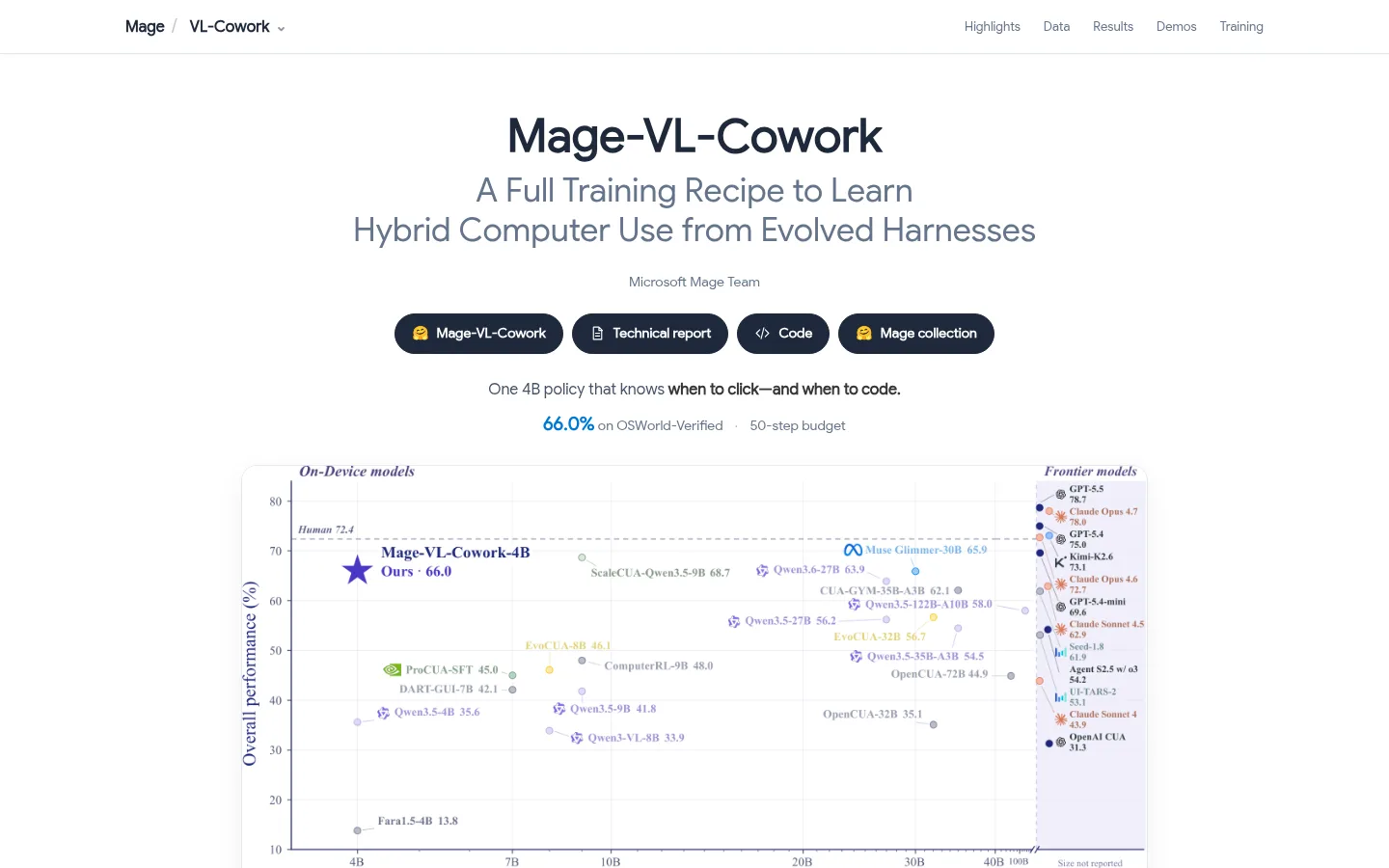
Mage-VL-Cowork is a 4-billion-parameter computer-use agent from Microsoft's Mage team, released as open weights under Apache 2.0. One vision-language model works a desktop through two channels: it clicks, types and scrolls from screenshots when a task needs the visual interface, and runs shell commands and Python when a file can be edited directly, choosing between them at every step without a separate orchestrator. Microsoft reports 66.0% on OSWorld-Verified within 50 steps, ahead of larger open models such as Qwen3.6-27B (63.9%) and OpenCUA-72B (44.9%), though frontier proprietary models such as GPT-5.5 (78.7%) remain ahead. It belongs to Microsoft's Mage family alongside Mage-VL and Mage-Flow.
Official source 1 ↗Features
- Clicks or codes, step by step. Each turn the model picks either a GUI action from the current screenshot (11 mouse and keyboard primitives) or a bash command in a persistent shell and Python environment. Official source 1 ↗ · Official source 2 ↗
- 66.0% on OSWorld-Verified at 4B. Measured on 361 held-out OSWorld-Verified tasks with a 50-step budget, averaged over two runs. It scores 87.5% on operating-system tasks and 62.7% on multi-application workflows. Official source 1 ↗
- Faster on file-heavy tasks. In Microsoft's side-by-side demo it finished a LibreOffice Calc task in 39 seconds and 6 steps by editing the workbook with Python, while GUI-only Qwen3.6-27B took almost 10 minutes and 39 steps. Official source 1 ↗
- Browser tasks too. Before reinforcement learning, the model already reached 58.6% on the offline WebVoyager-Static benchmark, second only to the browser-only Fara1.5-4B. Official source 1 ↗
- Compact working memory. The model keeps only the last three screenshots and four full responses, folding earlier steps into one-line action summaries, with a 32,768-token working context. Official source 1 ↗ · Official source 2 ↗
- Built on Mage-VL and Qwen3-4B. It pairs Microsoft's Mage-ViT vision encoder with a Qwen3-4B language model; reinforcement learning added 10.16 points over supervised training while cutting output tokens by 25.4%. Official source 1 ↗ · Official source 2 ↗
Pricing & free limits
A single 4B checkpoint on Hugging Face (about 9.48 GB in bfloat16). Your only cost is the hardware you run it on. Official source 1 ↗
Billing details
Billing details were not established by the checked official sources.
Free access & limits
Free access and its limits were not established by the checked official sources.
Best for & limitations
Research and benchmarking of small computer-use agents on OSWorld-style desktop tasks. Official source 1 ↗
Automating spreadsheet, document and presentation edits where scripting the file is faster than clicking through the app. Official source 1 ↗
Building an on-device or self-hosted desktop agent that does not depend on a proprietary API. Official source 1 ↗ · Official source 2 ↗
- Needs a sandbox. The model can run arbitrary shell commands and GUI actions. Microsoft designed and tested it for disposable containers or VMs and advises human confirmation before irreversible actions such as logins or payments. Official source 1 ↗
- Prompt-injection risk on the web. Microsoft recommends restricting network access when the agent reads untrusted web content, to limit indirect prompt injection. Official source 1 ↗
- Behind frontier models. Frontier proprietary models such as GPT-5.5 (78.7%) still score well above it, and the 9B ScaleCUA-Qwen3.5 model scores higher overall (68.7%). Official source 1 ↗
- Developer setup only. There is no app or hosted API: you need a GPU, Transformers or SGLang with trust_remote_code, and Microsoft's exact system prompt and harness. Its desktop results come from Linux desktops. Official source 1 ↗
- Benchmarks are Microsoft's own. The OSWorld and WebVoyager numbers come from Microsoft's report and project page rather than independent tests. Official source 1 ↗



 Submit a tool