What it does
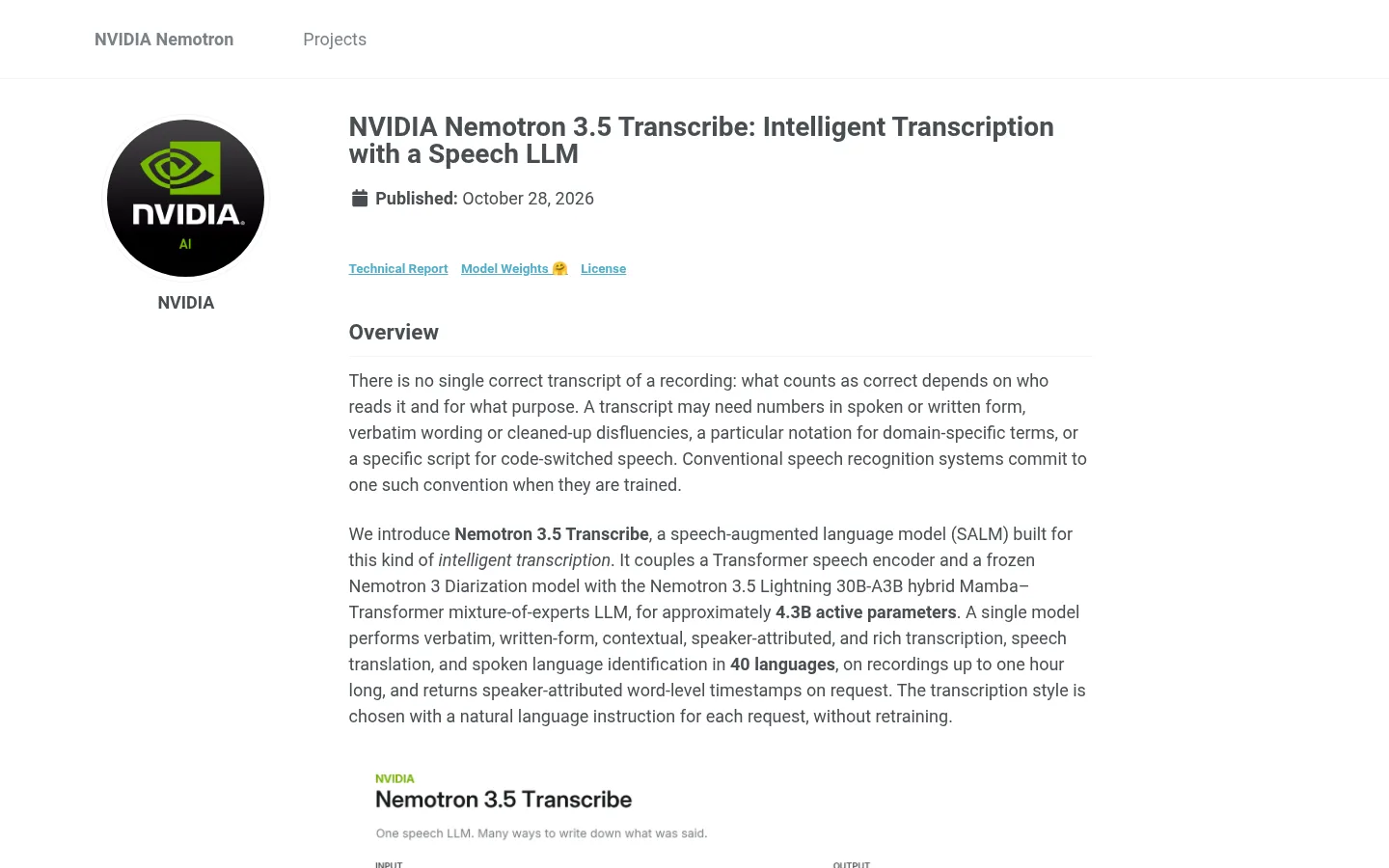
Nemotron 3.5 Transcribe is NVIDIA's open-weight speech model, published on 28 October 2026. It is a speech LLM: an audio encoder and a frozen Nemotron 3 Diarization speaker model feed the Nemotron 3.5 Lightning 30B-A3B mixture-of-experts language model, for 34B parameters in total and about 4.3B active. One model transcribes 40 languages verbatim or in written form, labels who is speaking, returns word timestamps, translates speech and identifies the language, on recordings up to one hour. You choose the transcript style with a plain-language instruction in each request. It processes whole recordings offline; it is not a streaming service.
Official source 1 ↗ · Official source 2 ↗Features
- Transcript style set by instruction. Instead of one fixed output convention, you ask for the style you need in the user message: verbatim with fillers and repetitions, cleaned-up readable text, numbers as spoken or in written form, or only the speaker nearest the microphone (marked experimental). No retraining is needed. Official source 1 ↗ · Official source 2 ↗
- Who said what, with word timestamps. Speaker-attributed transcription works on overlapping speech, from one-minute clips to full meetings and calls. A CTC alignment head adds word-level start and end times with speaker tags. On NVIDIA's full-session meeting and call tests (AMI, CALLHOME, Mixer 6, NOTSOFAR-1) it reports a mean cpWER of 15.80, against 16.83 for the next best published system. Official source 1 ↗ · Official source 2 ↗
- Context terms for names and jargon. You can pass a list of expected terms, such as product names or technical vocabulary, with the audio. NVIDIA reports six times fewer named-entity errors on ContextASR-Bench when it does, and suggests this for earnings calls, support recordings and technical discussions. Official source 1 ↗ · Official source 2 ↗
- 40 languages in three quality tiers. The model card rates each language. Leading (13, including English, Spanish, French, German, Hindi, Korean and Russian) is at or near state of the art out of the box. Production-ready (15, including Japanese, Thai, Turkish and Ukrainian) is production quality. Supported (12 transcribed languages, including Arabic, Mandarin Chinese and Vietnamese) may need fine-tuning. Code-switched speech, where people mix languages, is covered for every transcribed language. Official source 1 ↗
- Speech translation to and from English. The same model translates speech between English and 31 of its languages in both directions, and identifies the spoken language. Languages without translation include Turkish, Bengali, Indonesian, Marathi, Tagalog, Tamil, Telugu and Vietnamese. Official source 1 ↗ · Official source 2 ↗
- Top open-weight scores on the Open ASR Leaderboards. In NVIDIA's results (captured 12 October 2026), it has a mean WER of 4.71% on the nine English Open ASR Leaderboard sets, against 4.94% for Qwen3-ASR-1.7B, and 4.62% on the multilingual leaderboard, against 6.49%. Official source 1 ↗ · Official source 2 ↗
- Questions about a recording. With reasoning switched on, you can ask a question about the audio, for audio search, review and understanding. NVIDIA evaluated this only in English. Official source 1 ↗
- Fine-tuning and fast decoding. NVIDIA ships a fine-tuning toolkit in NeMo Speech and shows the model adapting to 17 new languages, domains or tasks on a single GPU, typically in 0.5 to 2.3 GPU-hours each. Built-in multi-token prediction and an optional DFlash2 draft model speed up decoding; on one H100, NVIDIA estimates about 410 seconds of audio processed per second for batched English transcription (MTP2). Official source 1 ↗ · Official source 2 ↗
Pricing & free limits
Download the BF16, FP8 or NVFP4 checkpoint, the GGUF files or the DFlash2 draft model and run them on your own NVIDIA GPU. NVIDIA says the model is ready for commercial or non-commercial use. Your only cost is the hardware; the reference setup is one H100 80 GB. Official source 1 ↗ · Official source 2 ↗
Billing details
Billing details were not established by the checked official sources.
Free access & limits
Free access and its limits were not established by the checked official sources.
Best for & limitations
Meeting and call transcripts that show who said what and when, for review and editing. Ask for speaker tags and word timestamps in the request. Official source 1 ↗
Captions, notes and searchable archives of recordings, using the readable style that drops fillers and accidental repetitions. Official source 1 ↗
Developers building transcription and translation tools, speech interfaces, media processing or customer-service analytics, and translating speech for multilingual media and localization. Official source 1 ↗
- Offline only, up to one hour. It transcribes finished recordings, not live audio; it is not a real-time streaming service. It was trained on recordings up to one hour and a 65,536-token context and is not guaranteed to work beyond that. A dense one-hour conversation can need about 20,000 output tokens. Official source 1 ↗
- Needs a data-centre or high-end NVIDIA GPU. NVIDIA's reference deployment is one H100 80 GB. The only consumer card in its compatibility table is the RTX 5090, and only with the NVFP4 checkpoint. It is built for NVIDIA GPUs, not CPUs. Official source 1 ↗
- Fastest serving is not in the open release. NVIDIA's headline speed (up to 2,238 seconds of audio per second on one RTX PRO 6000 Blackwell) comes from the optimized Nemotron Transcribe NIM. Those optimizations are not yet open source, and the release-day vLLM integration in NeMo Speech is expected to be about twice as slow. Official source 1 ↗
- Features differ by runtime. Word timestamps are not available with the DFlash2 draft model. The SGLang-Omni integration does whole-file transcription only, without word timestamps, speaker attribution, translation or speculative decoding. Timestamp requests take one recording at a time without streaming. Official source 1 ↗
- Uneven language support. Twelve transcribed languages are only rated Supported and may need fine-tuning, and eight have no speech translation. Audio question answering, reasoning and spoken instructions were evaluated only in English. Official source 1 ↗
- Can produce plausible but wrong output. NVIDIA warns that it may produce a plausible transcript that misrepresents the recording, and that speaker tags may attribute words to the wrong person. Speaker labels only separate voices; they do not identify real people. In rare cases generation loops, and NVIDIA provides a guardrail function for the output. Official source 1 ↗
- Vendor-run benchmarks. All scores on these pages are NVIDIA's own measurements. Official source 1 ↗