What it does
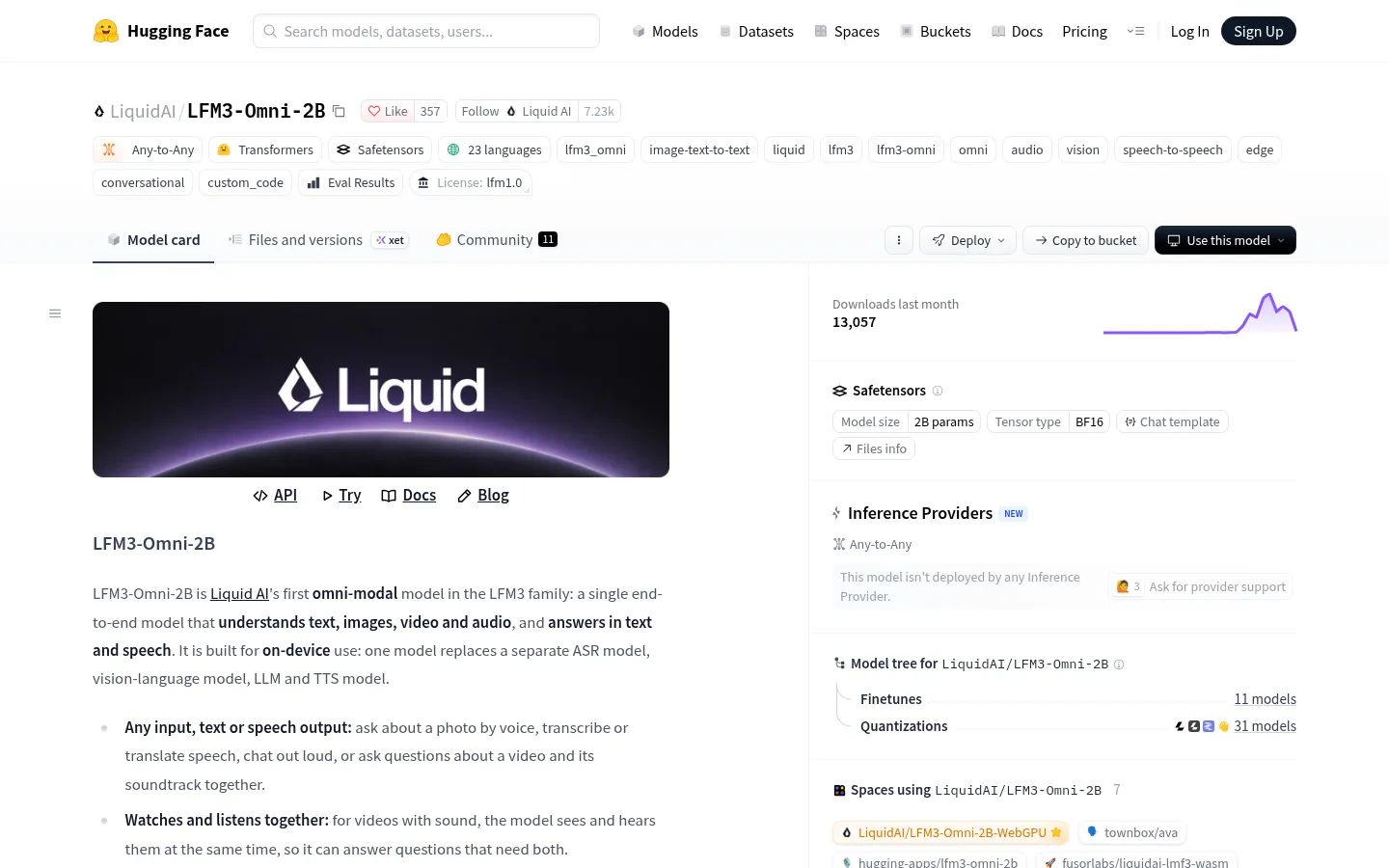
LFM3-Omni-2B is Liquid AI's first omni model, released on 27 October 2026 as part of the LFM3 family. One 2.2B-parameter model takes text, images, video (with or without its soundtrack) and audio, and answers in text, speech, or both interleaved, so it can stand in for a separate speech recognizer, vision-language model, LLM and text-to-speech model. It is built to run on phones, laptops and other edge hardware. The weights are on Hugging Face under the LFM Open License, and the model is also served through the Liquid API, OpenRouter and Vercel AI Gateway.
Official source 1 ↗ · Official source 2 ↗ · Official source 3 ↗Features
- Any input, text or speech output. Takes text, images, video with or without sound, and 16 kHz audio; answers as text, 24 kHz speech, or text and speech interleaved, within a 32K-token context. Official source 1 ↗
- Watches and listens at once. For a video with sound it processes frames and audio together, so it can answer questions that need both. Video is sampled at 2 frames per second, 4 to 384 frames. Official source 1 ↗
- Speech recognition, synthesis and translation. Works as an ASR model, as a text-to-speech model with a female or male voice in 19 speech languages and locales, and as a speech translator; Liquid says translation to or from English works best. Official source 1 ↗
- Spoken questions and tool calls. Ask about an image or a scene by voice and get a spoken or written answer, or turn spoken requests plus what the model sees into structured tool calls. Official source 1 ↗
- Fine-tunable. Liquid provides SFT notebooks to customise the model on your own text, audio and image data with Hugging Face Transformers. Official source 1 ↗
- Benchmarks against larger omni models. On Liquid's table it scores 70.09 on Daily-Omni (video plus audio), ahead of Qwen2.5-Omni-7B at 61.32, Gemma 4 E4B and Phi-4-multimodal. Official source 1 ↗
Pricing & free limits
Free for developers, researchers, non-profits and businesses with under $10M annual revenue, including production use. Fine-tunes can stay private. Official source 1 ↗ · Official source 2 ↗
Required for businesses with more than $10M in annual revenue that use the open weights in production. Official source 1 ↗
Image input $0.10 per 1M tokens; audio input $2.00 and speech output $10.00 per 1M tokens; cached text and image input $0.02. New organizations get $2 in free credit. Official source 1 ↗
Billing details
The API price is the same on Liquid Console, OpenRouter and Vercel AI Gateway; each platform bills you itself. Official source 1 ↗
Free access & limits
Every new Liquid Console organization gets $2 in free API credit. Official source 1 ↗
Best for & limitations
On-device voice assistants that see through a camera and answer out loud, such as a homework tutor or an in-car assistant. Official source 1 ↗ · Official source 2 ↗
Replacing a separate speech-to-text, vision, LLM and text-to-speech stack with one small model. Official source 1 ↗
Asking questions about a video and its soundtrack together, for example a recorded lecture or meeting clip. Official source 1 ↗
Voice-driven agents that turn spoken requests into structured tool calls. Official source 1 ↗
- Not open source in the OSI sense. The LFM Open License is based on Apache 2.0, but free commercial use ends once your company's annual revenue passes $10 million, and redistribution must keep Liquid's notices. Official source 1 ↗
- No reasoning mode. LFM3-Omni-2B is a non-reasoning model; thinking mode is not supported. Official source 1 ↗
- Behind larger models on some tasks. In Liquid's own tables it trails Qwen2.5-Omni-7B on OmniBench and Gemma 4 E4B on VoiceBench and spoken tool calling. Official source 1 ↗
- Vendor-reported scores. All benchmark scores were measured by Liquid AI. Official source 1 ↗
- Limited languages and context. Text is supported in 16 languages and speech in 19 languages and locales, with a 32K-token context shared by input and output. Official source 1 ↗