What it does
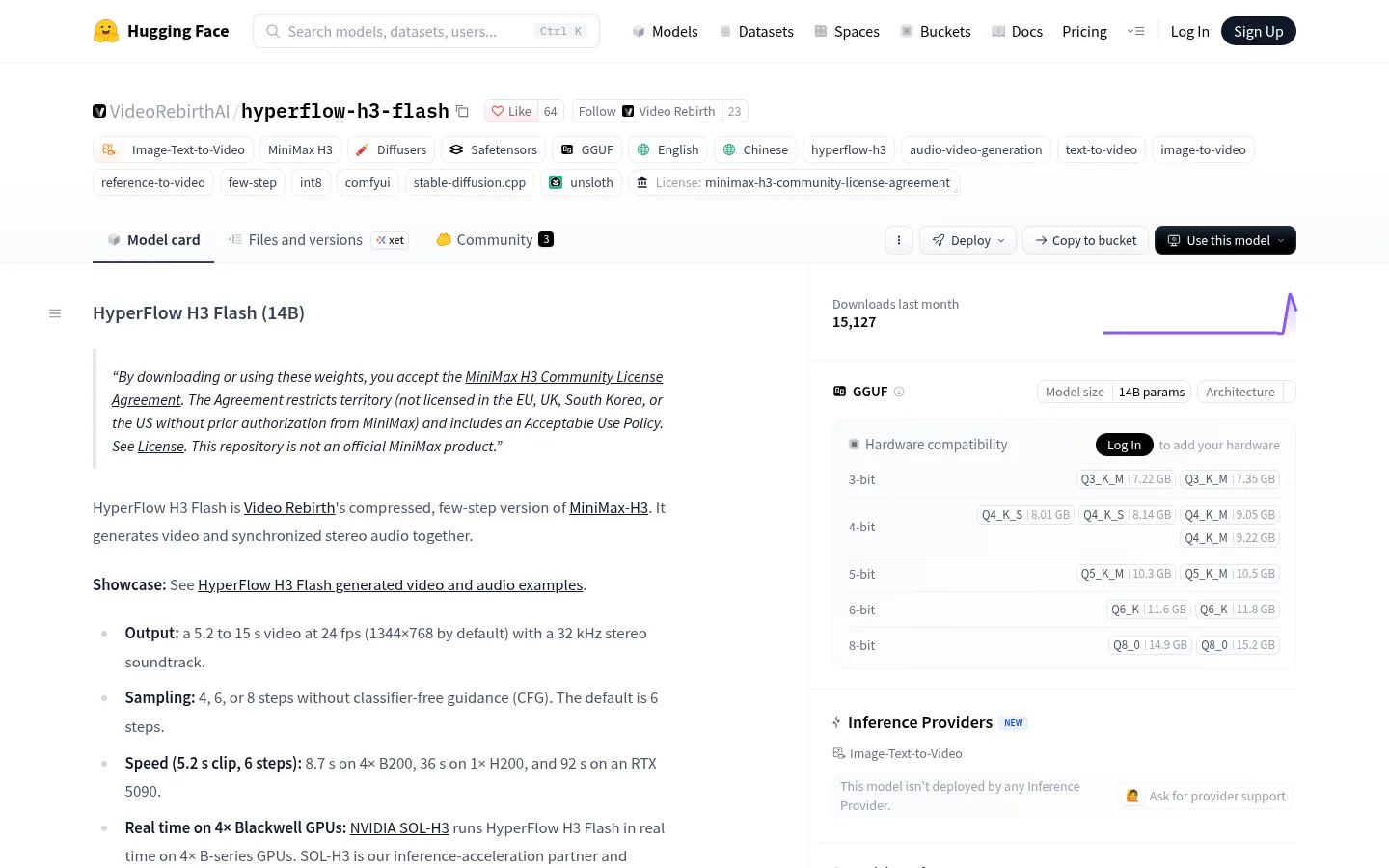
HyperFlow H3 Flash is a compressed, few-step version of MiniMax-H3 from Video Rebirth, released in early November 2026. It generates 5–15 second clips at 768p with a synchronized stereo soundtrack, from a text prompt, from first and last keyframes, or from up to 12 reference images, videos and audio clips. Pruning, low-rank factoring and INT8 cut the transformer from about 31B to 14B parameters and sampling to 4–8 steps, so a 4-bit GGUF build of 9.1 GB runs on a 24 GB consumer GPU. Weights are on Hugging Face under the MiniMax H3 Community License; it is not an official MiniMax product.
Official source 1 ↗Features
- Video and stereo audio in one pass. Each clip comes with a 32 kHz stereo soundtrack generated together with the picture, at 24 fps and 1344×768 by default, 5.2 to 15 seconds long. Official source 1 ↗
- Text, keyframe and reference modes. Generate from a prompt alone, from a first keyframe or a first and last keyframe pair, or from up to 12 references: 9 images, 3 videos and 3 audio clips. Official source 1 ↗
- Runs on a 24 GB consumer GPU. The recommended Q4_K_M build is 9.1 GB and runs on 24 GB and 32 GB GPUs in PCs with only 16 GB of system RAM. A 5.2-second clip takes about 2.5 minutes on an RTX 4090. Official source 1 ↗
- 4–8 sampling steps. Pick 4 steps for speed, 6 (the default) for balance or 8 for quality, without CFG. Video Rebirth reports a 12.7× speedup over MiniMax-H3 on one B200. Official source 1 ↗ · Official source 2 ↗
- ComfyUI templates. Install the ComfyUI-GGUF and HyperFlow nodes, add the text encoder and pick a template for text to video, image to video, first-last frame or reference to video. Official source 1 ↗
- One prompt for picture and sound. Describe subject, action, setting, camera movement and sound in a single prompt; negative prompts are not used. Official source 1 ↗
Pricing & free limits
GGUF and INT8 weights on Hugging Face. Use outside the US, EU, UK and South Korea is licensed; those regions need MiniMax's authorization, and products above $20M annual revenue need written permission. Official source 1 ↗
The Python package and CLI are Apache-2.0; the ComfyUI node is GPL-3.0 and the stable-diffusion.cpp patch is MIT. Official source 1 ↗
Billing details
There is nothing to pay Video Rebirth; the costs are your own GPU time and about 68–90 GB of first-run downloads for the Python package. Official source 1 ↗ · Official source 2 ↗
Free access & limits
No usage cap, but the license requires AI-generated disclosure on publicly shared output, forbids using outputs to train other models, and requires products to show "MiniMax H3" in their interface. Official source 1 ↗
Best for & limitations
Local text-to-video with matching sound effects or dialogue, without paying per clip to a hosted service. Official source 1 ↗
Animating between a first and last keyframe while generating audio for the shot. Official source 1 ↗
Keeping characters and voices consistent by feeding reference images, clips and audio. Official source 1 ↗
Real-time 768p generation experiments on four Blackwell GPUs. Official source 1 ↗ · Official source 2 ↗
- Not licensed in the US, EU, UK or South Korea. People and companies there must get MiniMax's prior authorization before downloading the weights. MiniMax says the restriction reflects video-model regulation and is "not yet", not permanent. Official source 1 ↗ · Official source 2 ↗
- Commercial strings attached. Products above $20M annual revenue need MiniMax's written permission, products must display "MiniMax H3", and outputs cannot be used to train other models. Official source 1 ↗
- Still slow on one consumer GPU. A 5.2-second clip takes about 2.5 minutes on an RTX 4090 and over 5 minutes on an RTX 3090; a 15-second clip takes about 14 minutes on the 4090. Real time needs four B200s. Official source 1 ↗
- Large companion downloads. The weights here are only the transformer: ComfyUI also needs a 15.7 GB text encoder, and the Python package downloads about 68–90 GB on first run. Official source 1 ↗ · Official source 2 ↗
- GGUF builds take image references only. Video and audio references require the Python INT8 package, which needs 69 GiB or more of system RAM on an RTX card. Official source 1 ↗
- Inherits MiniMax-H3's behaviour. Prompt adherence, languages, biases and failure modes follow the base model; it is a Video Rebirth derivative, not an official MiniMax release. Official source 1 ↗