



What it does
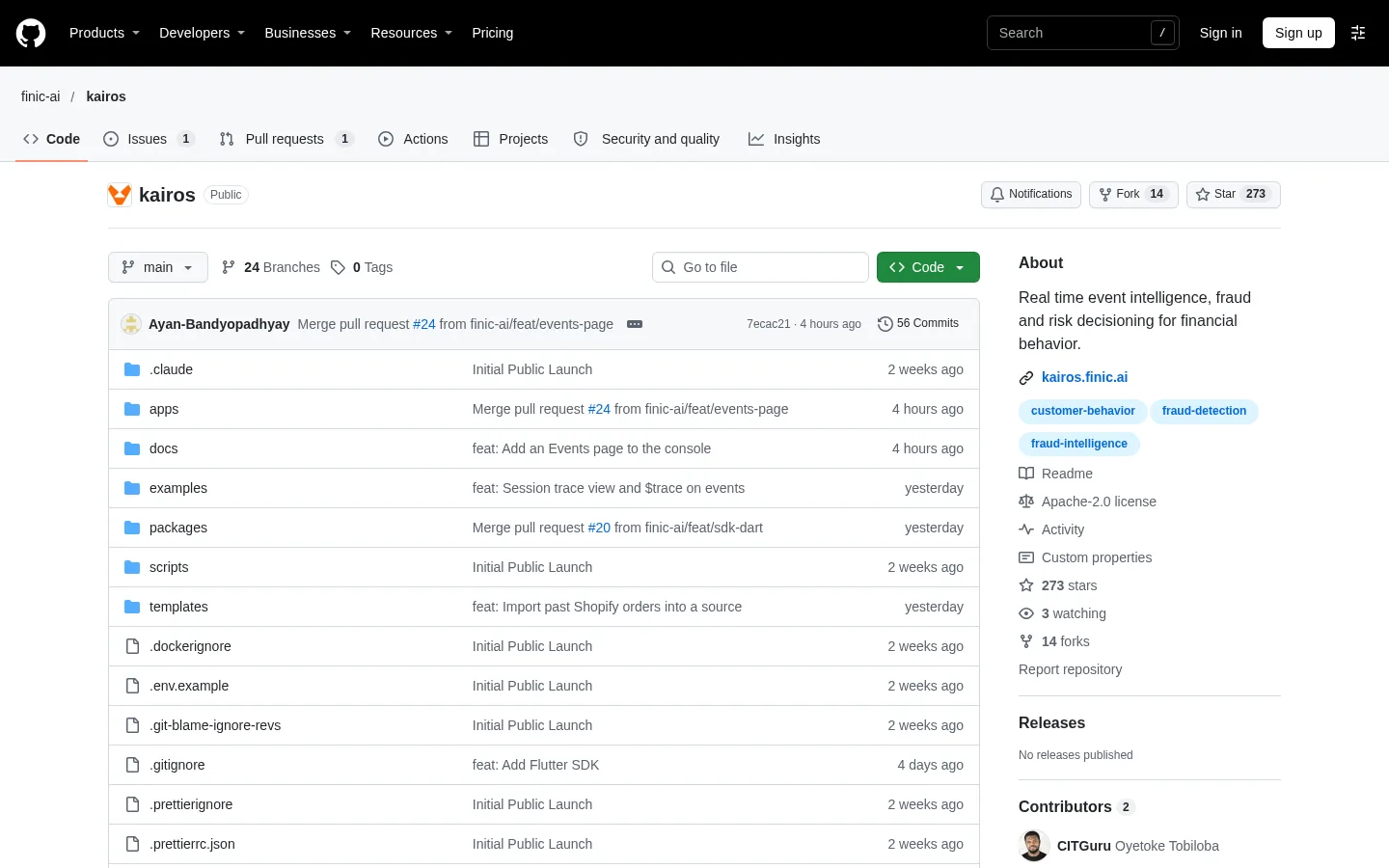
Kairos is an open-source fraud and risk decisioning platform from Finic. Your server sends it events such as sign-ups, logins, orders, payments and payouts, and asks for a decision; one call returns approve, step up, review or block with a risk score and the reasons. Scoring combines Finic's Grayson decision model, which answers plain-language questions about each request, with logistic regression or gradient-boosted trees trained on your own labels. An MCP server lets a coding agent such as Claude Code, Cursor or Codex build workflows and run model experiments. Finic positions it as an open-source alternative to Sardine, Sift, Riskified and SEON.
Official source 1 ↗Features
- Real-time decisions. One call returns approve, step up, review or block for a sign-up, login, order, payment or payout, with a risk score and reasons drawn from the subject's history, shared devices, cards and addresses, and the session. Official source 1 ↗
- Grayson decision model. You write plain-language questions (is this email throwaway, does this address look like a reshipper) and Grayson answers each with a calibrated probability. It works before you have many fraud labels and reads unstructured text such as names, notes and item titles. Official source 1 ↗
- Your own ML models. Grayson's answers become features next to your own fields in logistic regression or XGBoost-compatible gradient-boosted trees, trained inside Kairos or uploaded. Official source 1 ↗
- Agent-run experiments over MCP. Connect Claude Code, Cursor or Codex and the agent can build workflows, propose model variants and ship the winner. Kairos trains each variant on older labels and reports ROC-AUC, PR-AUC and precision and recall on the newest data. Admins choose which tool groups (Read, Write, Decide, Build) the agent gets. Official source 1 ↗ · Official source 2 ↗
- Workflows, queues and cases. Workflows can ask the model, score, branch, call webhooks and open cases. Review queues hand cases to people, and their resolutions become training labels. Official source 1 ↗
- SDKs, CLI and self-hosting. TypeScript and Python SDKs, a CLI and an HTTP API, with a Docker setup for running your own server. Official source 1 ↗
Pricing & free limits
Run the server and console yourself on Node.js 22 with Postgres. Decisions call Finic's Grayson model, so a Grayson API key is still required. Official source 1 ↗ · Official source 2 ↗

The Finic decision model behind Kairos decisions. Access is by request to Finic. Official source 1 ↗
Sign up, create a sandbox environment and a secret key, and send events without running a server. No price is published on the pages checked. Official source 1 ↗
Billing details
Billing details were not established by the checked official sources.
Free access & limits
Free access and its limits were not established by the checked official sources.
Best for & limitations
Fintech and marketplace teams deciding sign-ups, logins, payments and payouts in real time, as an open-source alternative to Sardine, Sift, Riskified or SEON. Official source 1 ↗
Shopify stores that want to hold risky orders for review and learn from chargebacks. Official source 1 ↗
Teams with few fraud labels yet, who start with the Grayson model and add trained models later. Official source 1 ↗
Developers who want a coding agent to tune fraud models: it designs variants, Kairos tests them, and the agent ships the winner. Official source 1 ↗
- Self-hosting still depends on Finic. Every decision calls Finic's hosted Grayson model, so a self-hosted server needs internet access and a Grayson API key, and Finic's per-second request limit caps throughput. Official source 1 ↗
- Model scores are not perfectly repeatable. Finic reports that in a test of 100 identical requests, 25 changed probability by up to 0.06, so decisions near a threshold can flip. Official source 1 ↗
- Thresholds and tuning are left to you. The default policy blocks at 0.9 and reviews at 0.5 as placeholders; there is no threshold tuning or shadow mode built in. Official source 1 ↗
- No step-up or email flows. Kairos returns step_up or review but does not run the next step; there is no email, password reset or email verification. Official source 1 ↗
- Limited history and link depth. A decision reads only the subject's latest 2,000 events, and shared-device links go only one hop. Official source 1 ↗
- Vendor benchmarks and young project. Finic's speed and accuracy claims come from its own test at one unnamed company. Sign-in has no rate limit and API key IP ranges are IPv4 only. Official source 1 ↗ · Official source 2 ↗