What it does
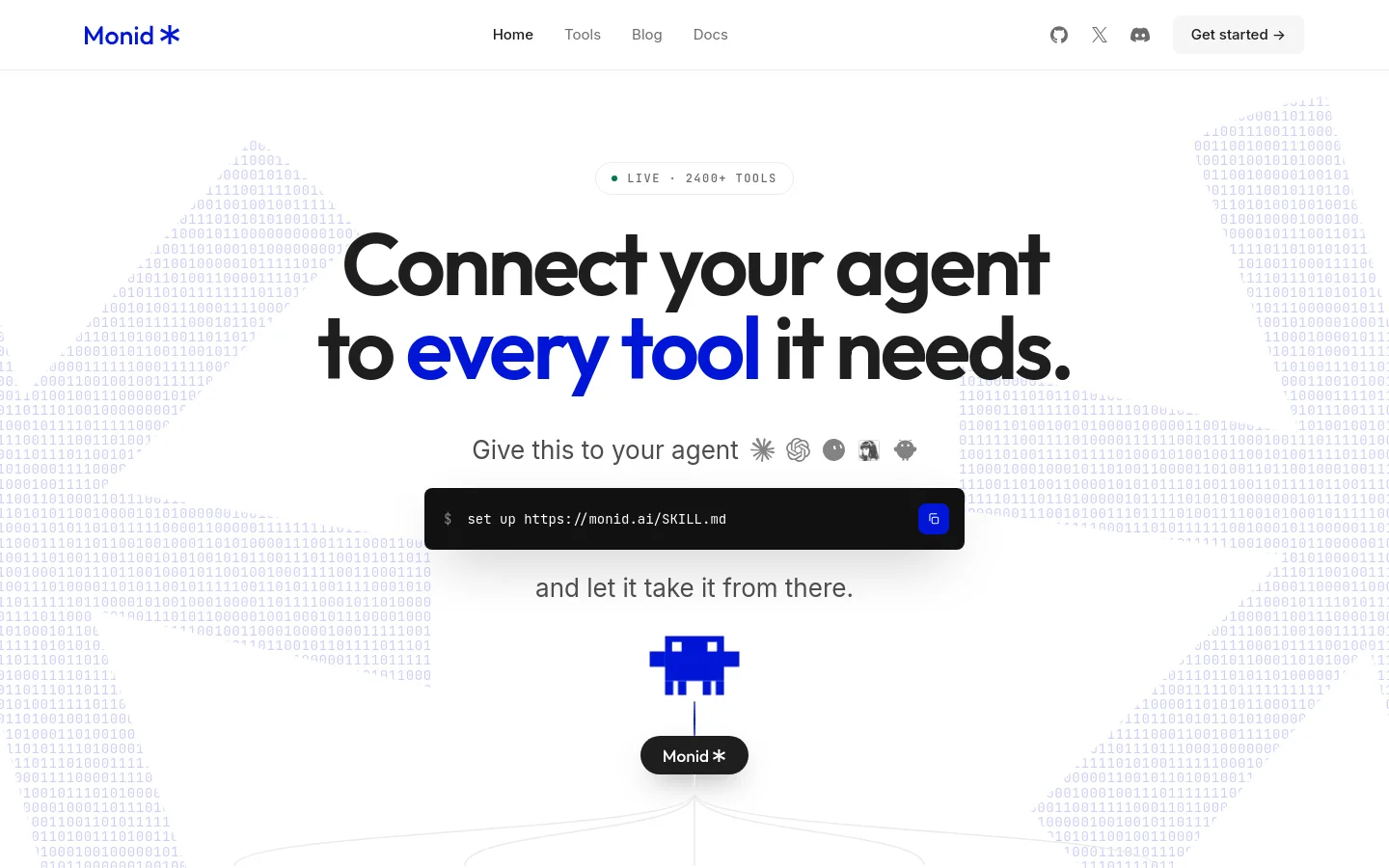
Monid is a tool and API gateway for AI agents and developers. Agents discover endpoints for a task, inspect their inputs and prices, then execute them through a shared interface and wallet. It supports search, data collection, sales research and creative workflows through connected providers.
Official source 1 ↗ · Official source 2 ↗Features
- Discover tools as the task runs. Search for data endpoints in natural language and let an agent select a suitable tool at runtime without loading every endpoint into its prompt. Official source 1 ↗
- Inspect schemas and prices before executing. Inspect an endpoint to see its input schema, output shape and price before making a call. Detailed inspection also exposes documentation and operator notes where available. Official source 1 ↗ · Official source 2 ↗
- One interface and prepaid wallet. Use one API and wallet across providers, paying for the endpoints you use instead of maintaining separate subscriptions for each provider. Official source 1 ↗
- MCP, Skill, CLI and API access. Give an existing agent access through MCP or a Skill, or call endpoints from scripts and application code. Remote MCP uses Streamable HTTP and does not require the CLI. Official source 1 ↗ · Official source 2 ↗
- Synchronous and background execution. Some providers return results immediately. Others return a run ID and execute in the background; the CLI can poll for results, save output to a file, and stop queued or running runs. Official source 1 ↗ · Official source 2 ↗
- Embed the marketplace in another product. Integrate Monid server-to-server, let users connect their own workspace with OAuth, or place your own proxy in front to control validation, billing and endpoint access. Official source 1 ↗
- Optional USDC payments with x402. Execute eligible runs with a funded crypto wallet instead of a prepaid workspace balance. Discovery and inspection still require a normal Monid API key. Official source 1 ↗
Pricing & free limits
Billing details
Check the actual endpoint quote rather than treating a homepage example as a platform-wide rate. Prices appear in discovery and inspection; the run response shows the actual execution charge. Official source 1 ↗
The execution reference says provider errors are not charged. A completed run can still contain a provider error or no match, so check both the lifecycle status and the provider HTTP status. Official source 1 ↗
High-volume users can contact support to discuss volume-based discounts. Official source 1 ↗
Free access & limits
The homepage advertises $1 in starting credit. This is an introductory allowance alongside paid usage; the checked public pricing pages do not establish a recurring free allowance or an expiry period. Official source 1 ↗ · Official source 2 ↗
The x402 guide lists discovery and inspection as requiring an API key but no payment. Executing a paid endpoint is a separate charge. Official source 1 ↗
Best for & limitations
Build a competitor research report covering competing products, pricing, features, positioning and recent social discussion. Official source 1 ↗
Find sales leads that match a target market, then enrich contacts with public profiles and contact details. Official source 1 ↗
Analyze customer sentiment using recent product reviews and social media evidence. Official source 1 ↗
Support SEO research by prioritizing content opportunities and comparing brand citation counts with competitors. Official source 1 ↗
Use an existing agent to turn a product photo into a short promotional clip or create a narrated news briefing through suitable tools. Official source 1 ↗
- An agent connection and account setup are required. The Skill workflow requires a Monid account and API key; MCP requires signing in and authorizing the connection. Monid supplies tools to an existing agent or application. Official source 1 ↗ · Official source 2 ↗
- A completed run does not guarantee useful data. Check the provider response as well as the run status. A completed run may mean no match; provider codes also distinguish rate limits and provider errors. Official source 1 ↗
- Background jobs need polling. Asynchronous endpoints return a run ID rather than final output. Poll until a terminal status before using the result; endpoint execution times vary with the provider and data volume. Official source 1 ↗ · Official source 2 ↗
- x402 has a price floor and endpoint restrictions. x402 raises cheaper quotes to US$0.01, excludes time-billed endpoints, and does not support listing runs. Save each run ID or poll URL to retrieve results later. Official source 1 ↗
- Documentation examples are illustrative. The published use-case examples contain fictional sample outputs and suggested tools. Their names, counts, prices and measurements are not evidence of real execution results. Official source 1 ↗