



What it does
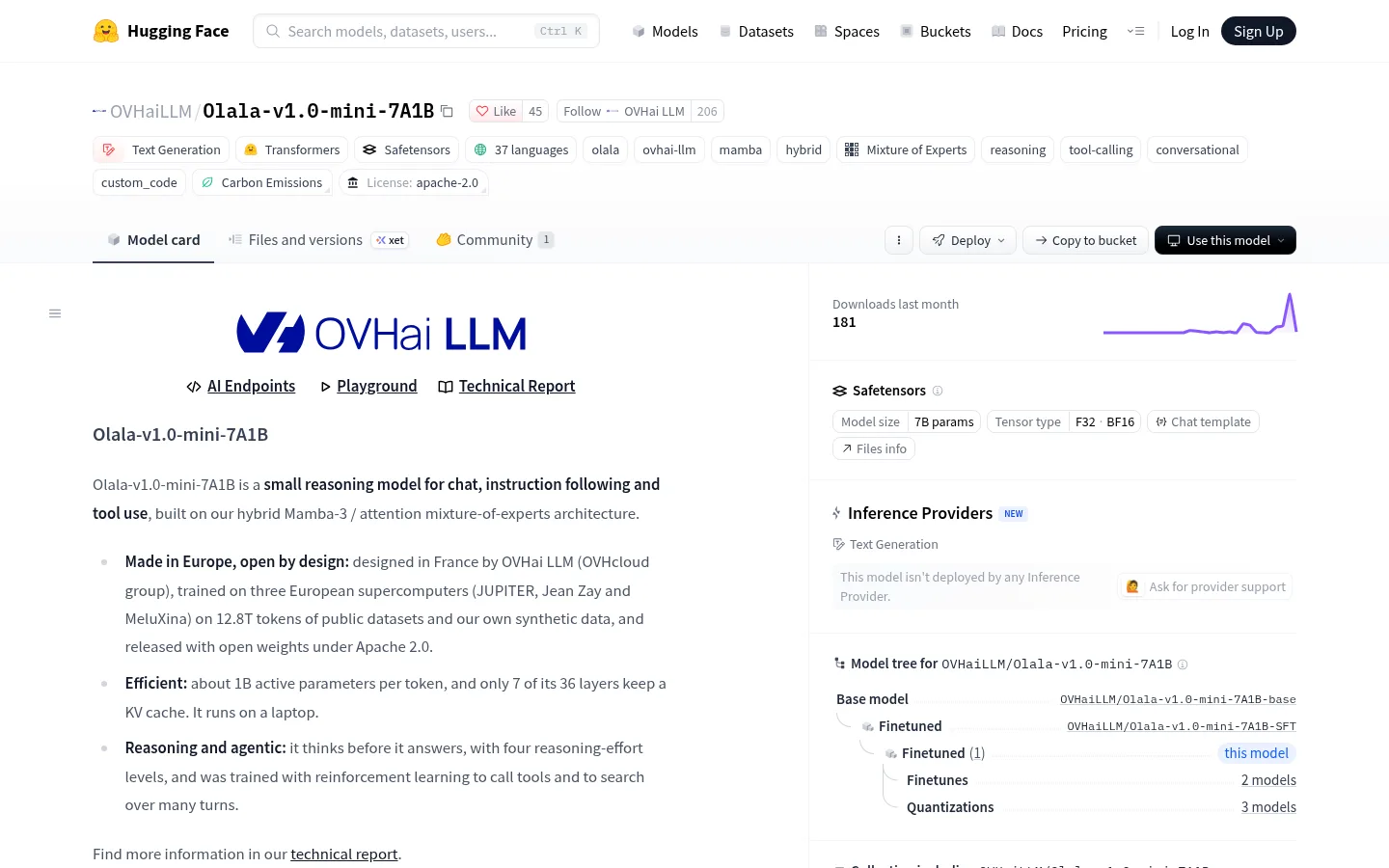
Olala-v1.0-mini-7A1B (Olala 1.0 mini) is a small open-weight reasoning model from OVHai LLM, part of the OVHcloud group, released on Hugging Face on 19 November 2026 under Apache 2.0. It is a text-only model for chat, instruction following and tool use, built on a hybrid of Mamba-3 and attention layers with a mixture of experts: 6.8B parameters in total, of which about 1B are active for each token, which is why it can run on a laptop. It reasons before it answers, with four effort levels, and has a 32K-token context. OVHcloud says it was designed in France and trained on three European supercomputers on 12.8T tokens of public and synthetic data. You can download the weights, or call it through OVHcloud AI Endpoints, where it is currently listed as free.
Official source 1 ↗Features
- About 1B active parameters. Of the 6.8B parameters, about 1B are used for each token, and only 7 of the 36 layers keep a KV cache. This is what the "7A1B" in the name appears to point to; the card gives the figures but does not spell the name out. Official source 1 ↗ · Official source 2 ↗
- Reasoning with effort levels. The model thinks before it answers and returns its reasoning separately. The card describes four reasoning-effort levels; the AI Endpoints example exposes low, medium and high. Official source 1 ↗ · Official source 2 ↗
- Tool calling. It was trained with reinforcement learning to call tools and to search over several turns, and the hosted endpoint lists function calling, streaming and JSON schema output. Official source 1 ↗ · Official source 2 ↗
- Laptop-sized files. OVHai LLM publishes its own quantised files: a 6.3 GB 6-bit GGUF that runs at about 70 tokens a second on a 16 GB MacBook Air M5, and a 5.4 GB MLX build at about 86 tokens a second. On CPU alone it is much slower. Official source 1 ↗ · Official source 2 ↗ · Official source 3 ↗

- 38 training languages. Pre-trained on English and 36 other languages, mostly European, plus Arabic, Chinese, Japanese and Korean. Official source 1 ↗
- Fine-tuning image. A ready-to-run Docker image trains a LoRA adapter on your examples and merges it into a complete model, without writing training code. Official source 1 ↗
- Published benchmarks. OVHai LLM reports an average of 68.0 over twelve benchmarks, 15.2 points above the checkpoint before reinforcement learning, strongest on instruction following and weakest on competition mathematics. These are its own runs. Official source 1 ↗
Pricing & free limits
Billing details
Billing details were not established by the checked official sources.
Free access & limits
AI Endpoints without an account: 2 requests a minute, per IP and per model. With an API key: 400 requests a minute per Public Cloud project and per model. Official source 1 ↗
Best for & limitations
Running a private assistant on a 16 GB laptop for short questions, drafting and instruction-following tasks. Official source 1 ↗ · Official source 2 ↗ · Official source 3 ↗
Building tool-calling agents on an Apache 2.0 model hosted in Europe, through an OpenAI-compatible API. Official source 1 ↗
Adapting a small European model to your own data with the LoRA fine-tuning image, or picking the sibling models tuned for summarising and translation. Official source 1 ↗
- Needs OVHai LLM's forks. Ollama, LM Studio and the standard llama.cpp and mlx-lm cannot load the model yet. Local use means building or installing OVHai LLM's own forks. Official source 1 ↗ · Official source 2 ↗
- Less knowledge than larger models. The card says that with about 1B active parameters it stores less factual knowledge than larger models and can state wrong facts with confidence. Its training data stops in January 2026. Official source 1 ↗
- 32K context, text only. Input and output share a 32K-token window, and the model takes text only. A 128K-context version is announced but not released. Official source 1 ↗
- Can loop or over-refuse. Long reasoning can fall into a repetition loop. In OVHai LLM's own tests 6.3% of attack prompts still succeeded, and the model refuses about 1 benign request in 10. Official source 1 ↗
- Use the official quantised files. Generic quantisation recipes produce NaN on realistic inputs, and there is no 4-bit file: a Q4_K_M build was tested and withdrawn. Official source 1 ↗ · Official source 2 ↗
- Vendor-run numbers. The benchmark, speed and safety figures all come from OVHai LLM's own runs. The emissions figure (about 40 t CO₂e) is also its own estimate. Official source 1 ↗