What it does
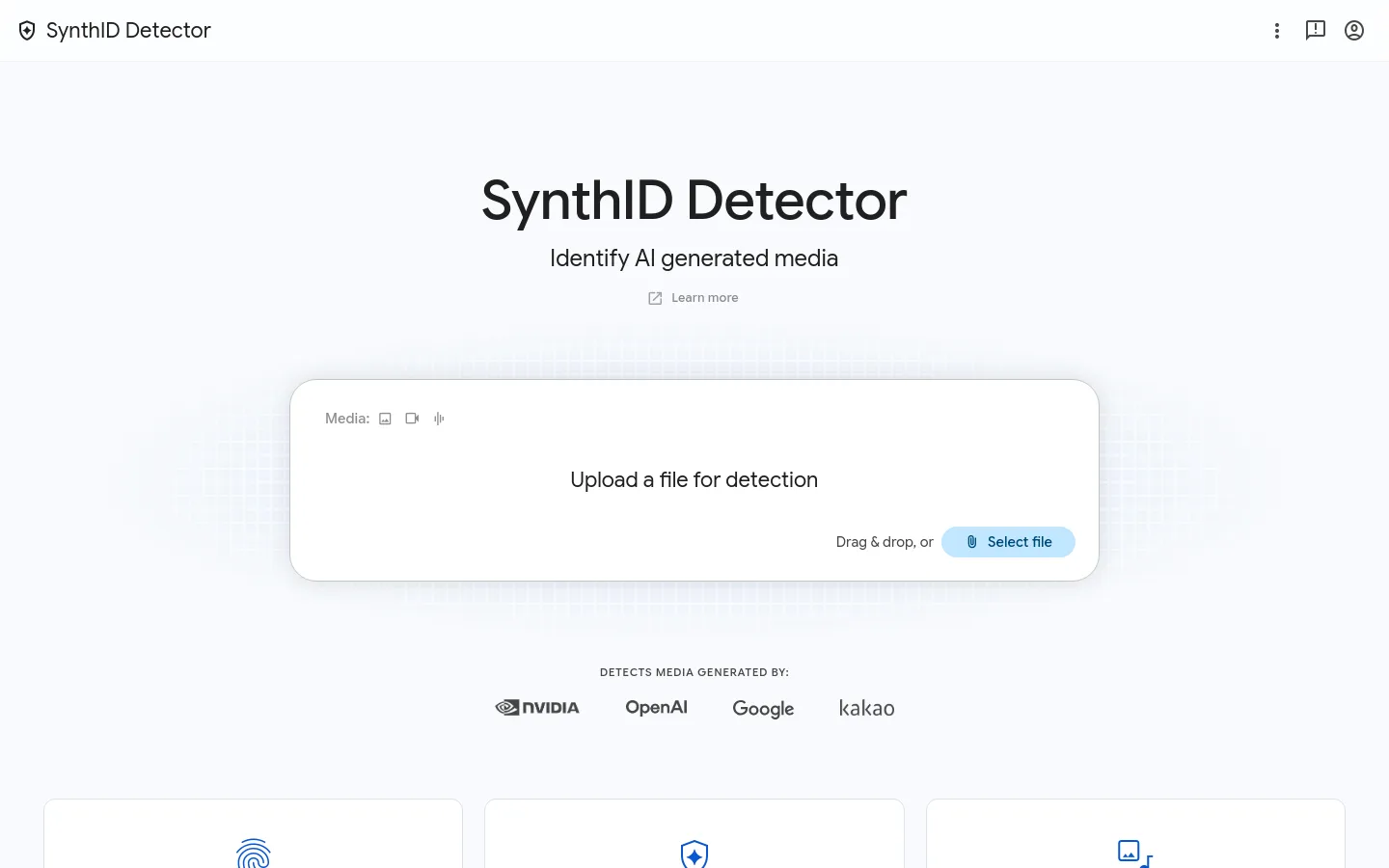
SynthID Detector is Google DeepMind's web portal for checking whether an image, video or audio file carries a SynthID watermark. SynthID is an invisible watermark added when content is generated by models from Google and its partners OpenAI, NVIDIA and Kakao. You upload a file and the portal reports whether a watermark was found, marking the affected segments for video and audio. It opened to everyone, in English, on 7 October 2026 after a test phase with journalists and media professionals.
Official source 1 ↗ · Official source 2 ↗ · Official source 3 ↗Features
- Image, video and audio checks. Detects a SynthID watermark in images, and marks the segments of a video or audio file that carry one. Official source 1 ↗
- Cross-company coverage. Recognises watermarks from generative products by Google, OpenAI, NVIDIA and Kakao; Google says Apple support is coming. Official source 1 ↗ · Official source 2 ↗
- Broad file support. Accepts JPG, PNG, WEBP, AVIF, HEIC, TIFF and GIF images; MP4, MOV and WEBM video; and WAV, MP3, OGG, FLAC, AAC and M4A audio. Official source 1 ↗
- Plain-language results. Each check returns “watermark detected” or “watermark not detected”, with guidance on what a negative result does and does not prove. Official source 1 ↗
- Robust, invisible watermark. The watermark is imperceptible and is designed to survive filters, colour changes and lossy compression. Official source 1 ↗
Pricing & free limits
Billing details
Billing details were not established by the checked official sources.
Free access & limits
Each account has daily usage quotas. Creating extra accounts or using automation to get around them breaches the terms, and Google may suspend access. Official source 1 ↗
Best for & limitations
Check whether a viral image, clip or audio recording was generated or edited with Google, OpenAI, NVIDIA or Kakao AI before sharing or reporting on it. Official source 1 ↗ · Official source 2 ↗
Verify the provenance of user-submitted media in a newsroom or fact-checking workflow, alongside other evidence. Official source 1 ↗ · Official source 2 ↗
- Not a general AI detector. It only detects media from companies that have adopted SynthID. A “not detected” result does not rule out AI generation, for example by a non-partner model. Official source 1 ↗
- Heavy edits can remove the signal. Heavy compression or editing can degrade the watermark, and in rare cases the detector falsely triggers on unwatermarked content. Official source 1 ↗
- Generated versus edited is not separated. A detected watermark means the file was likely generated or edited by a SynthID-enabled model; the result does not say which. Official source 1 ↗
- No bulk or API use. The terms forbid submitting requests programmatically or running bulk verification through the portal. Official source 1 ↗
- English only. The portal launched globally with an English-only interface. Official source 1 ↗