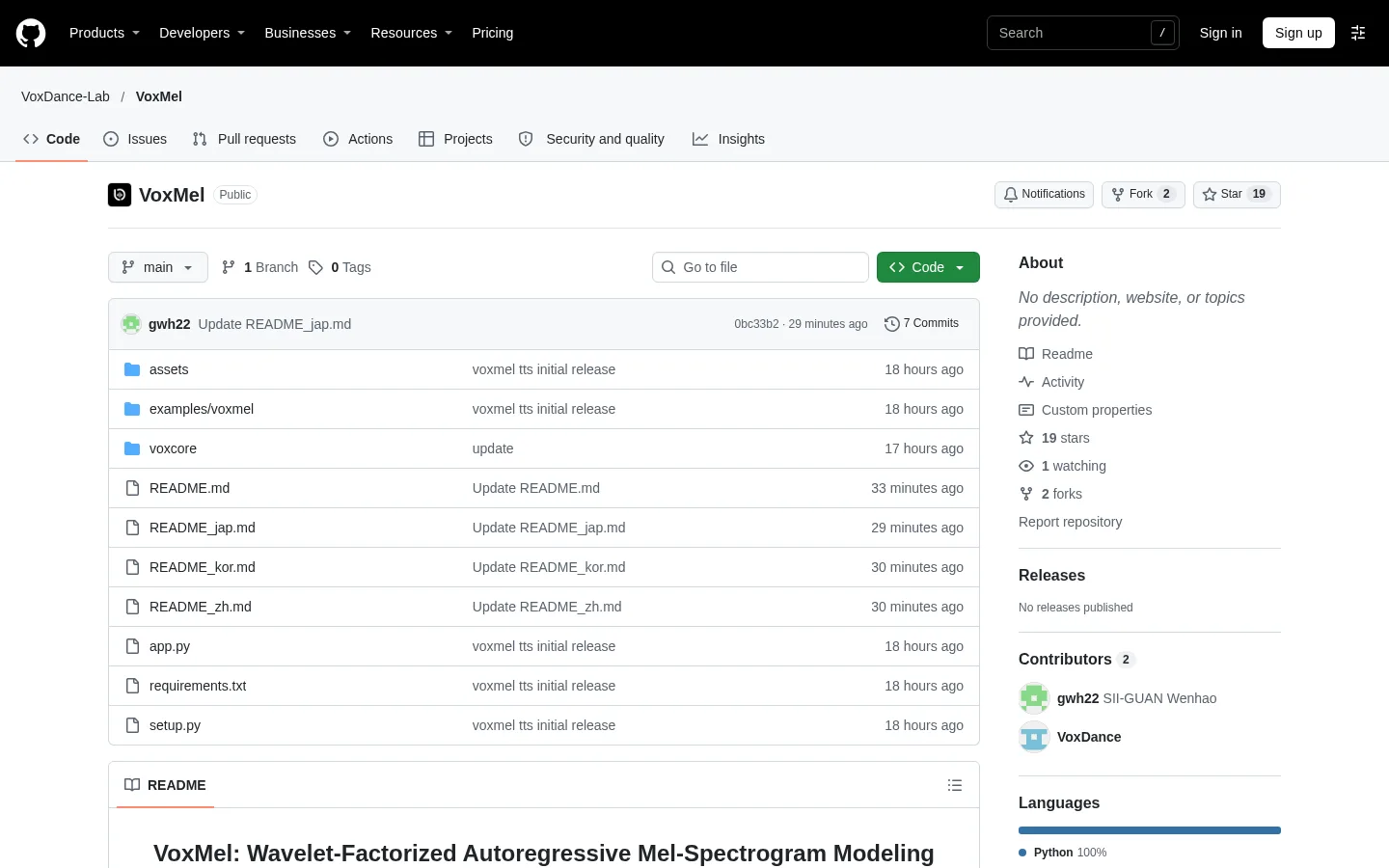
What it does
VoxMel is an open text-to-speech model from VoxDance Lab that clones a voice from a short reference recording and its transcript, in English and Chinese, with no training. It was released in November 2026 in two sizes, 0.6B and 0.3B, under Apache 2.0. Unlike most recent TTS models, it skips the learned audio tokenizer: it generates the mel-spectrogram directly, a coarse version first and the fine detail after, and a Vocos vocoder turns that into 24 kHz audio. Trained on 100K hours of the Emilia dataset, the 0.6B model reports 1.51% English word error on Seed-TTS-eval, or 1.15% after reinforcement-learning post-training.
Official source 1 ↗Features
- Zero-shot voice cloning. Give it reference audio and the exact transcript of what is said in it, and it speaks new text in that voice. The demo page shows the same voices speaking both English and Chinese, so a Chinese voice can read English and the other way round. Official source 1 ↗ · Official source 2 ↗
- No audio tokenizer. VoxMel models mel-spectrograms directly instead of compressing audio into learned tokens or latents. A language-model backbone generates a coarse mel first; two non-autoregressive stages then add timing and frequency detail. Official source 1 ↗
- Two small checkpoints. VoxMel-0.6B has 690.1M parameters (backbone initialized from Qwen2.5-0.5B) and VoxMel-0.3B has 312.2M, plus a 13.6M-parameter Vocos vocoder. Only the 0.6B model got the GRPO post-training. Official source 1 ↗
- Seed-TTS-eval results. VoxDance reports 1.51% English WER and 0.738 speaker similarity for the supervised 0.6B model, and 1.15% / 0.753 after GRPO, the best English scores in its comparison table of 17 other systems including CosyVoice 3, Qwen3-TTS and VoxCPM. Chinese CER is 1.29%, or 1.17% with GRPO. Official source 1 ↗
- Controllable generation. Separate text and speaker guidance strengths, solver steps and duration bounds; the API returns a mono waveform you can save as a WAV file. Official source 1 ↗
- Listening demo. The project page plays VoxMel next to VoxCPM, MaskGCT, CosyVoice 2 and IndexTTS 2 on Seed-TTS prompts, plus emotional samples (happy, angry, sad, calm) with waveform and mel-spectrogram views. Official source 1 ↗
Pricing & free limits
Billing details
Billing details were not established by the checked official sources.
Free access & limits
Free access and its limits were not established by the checked official sources.
Best for & limitations
Developers who want a small, Apache-licensed voice-cloning TTS model for English and Chinese that they can run and ship themselves. Official source 1 ↗ · Official source 2 ↗
Reading English text in a Chinese speaker's voice, or Chinese text in an English speaker's voice, for bilingual narration or dubbing tests. Official source 1 ↗
Speech researchers comparing tokenizer-free mel modeling against codec-based TTS, with the Seed-TTS batch evaluation script in the repository. Official source 1 ↗
- English and Chinese only. VoxMel is trained and evaluated on English and Chinese zero-shot cloning; no other languages are listed. Official source 1 ↗ · Official source 2 ↗
- Cloning only, with a transcript. Generation needs reference audio plus its exact transcript; the bundled web demo supports voice cloning only, and speaker guidance applies only with reference audio. Official source 1 ↗
- Developer setup, no hosted app. You install the Python package, then download the VoxMel weights, config and Vocos weights separately and point the code at them. Apple Silicon support is not yet validated. Official source 1 ↗
- Self-reported benchmarks, paper pending. All scores come from VoxDance's own table, and the technical report is still marked coming soon. On Chinese, OmniVoice-Emilia (0.89% CER) and VoxCPM (0.93%) beat VoxMel's 1.17%, and CosyVoice 3 has higher Chinese speaker similarity. Official source 1 ↗
- Smaller model has no RL post-training. The GRPO improvements apply to the 0.6B model only; VoxMel-0.3B did not get that post-training. Official source 1 ↗
- Test before production. VoxDance recommends thorough testing and safety evaluation before production use, and the invertible transform does not guarantee lossless generated audio. Official source 1 ↗ · Official source 2 ↗




 Submit a tool