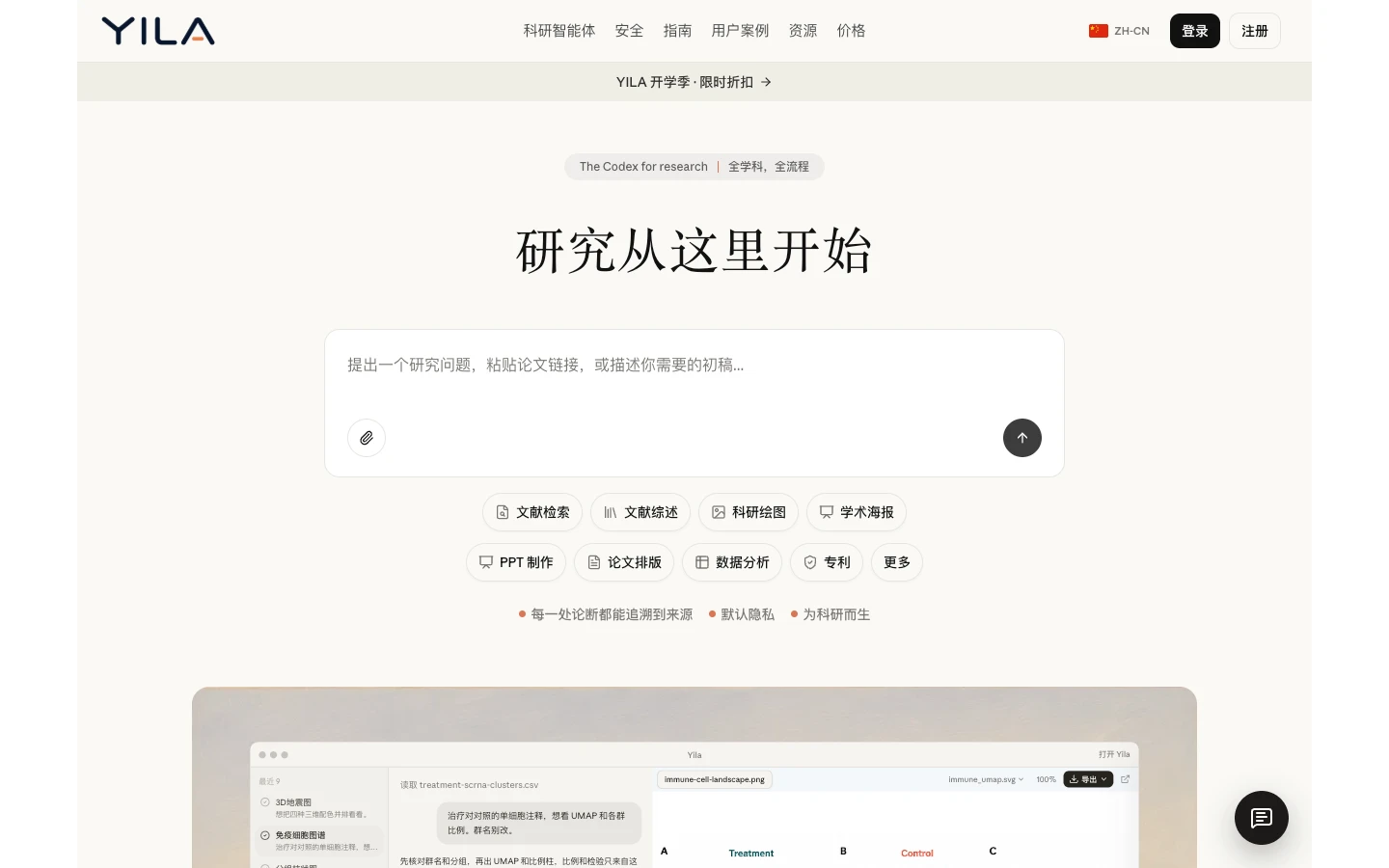
What it does
Yila is a web workbench of AI research agents for academic work. You start from a research question, a paper URL or a draft, and pick an agent for one stage of the job: checking whether a topic is still open, searching scholarly databases, triaging and deep-reading papers, drafting a cited literature review, polishing and typesetting a manuscript, analysing data, or turning a paper into figures, a poster or slides. Yila says every claim is traced to a source and that work is private by default.
Official source 1 ↗Features
- Literature search. Describe a topic and Yila searches scholarly databases, builds a quality-ranked candidate pool and returns papers with abstracts, citation signals and key findings. Yila says the papers are verified and citations are never invented. Official source 1 ↗
- Cited literature reviews. The Literature Review agent searches and reads 50+ full papers, compares methods, findings and evidence strength, then drafts a citation-backed review you can keep editing. Official source 1 ↗
- Research gap and topic validation. Enter a research idea and Yila finds the closest existing work, labels the gap Open, Occupied, Ambiguous or Unsupported, assesses novelty, significance and feasibility, and suggests reframed candidate topics. Deliverables are a markdown validation report and a ranked candidate-topic spreadsheet. Official source 1 ↗
- Paper deep reading and bilingual reading. Paper Card Deep Reading reconstructs a paper's argument, design and key evidence, marks missing details as Not reported, and returns a paper card, an evidence index and an annotated PDF. A separate Bilingual Reading agent shows papers line by line, side by side. Official source 1 ↗ · Official source 2 ↗
- Mock peer review. Upload a manuscript (PDF, DOCX, TXT or Markdown) and Yila produces three reviewer-style reports on contribution, methods, evidence, audience and readability, then synthesises consensus, disagreements and revision priorities. Official source 1 ↗
- Writing, polish and typesetting. Writing agents turn results and notes into manuscript sections, polish prose for a target journal, and format a manuscript to a journal template, thesis guide, Word template or LaTeX kit while carrying tables, figures and equations over. Official source 1 ↗
- Data analysis and research design. Upload a CSV or XLSX file and Yila profiles the data, picks an analysis method for your question and returns results, charts and reusable code. A Research Design agent turns a question into an executable plan, and a Stats + Write-up agent goes from statistical tests to written results. Official source 1 ↗
- Figures, posters and slides. Generate a scientific figure from a one-sentence description with editable exports, turn an uploaded paper into a conference poster from a template, or turn a paper into an editable PowerPoint deck. Official source 1 ↗
Pricing & free limits
10,000 credits per period. Standard scope for literature search, figures, posters and multi-step long tasks; standard support. Official source 1 ↗
30,000 credits per period. Extended literature search scope, parallel research topics, larger long-task allowance; priority support. Official source 1 ↗
60,000 credits per period. Review-scale literature search, high figure and poster volume, batch delivery; dedicated support. Official source 1 ↗
Billing details
Plans can be billed monthly, yearly (advertised as 20% off) or as a lifetime purchase (advertised as 30% off). Credits refresh with each successful renewal. Official source 1 ↗
Payments are processed by Stripe and can be made by card or WeChat Pay. Official source 1 ↗
At the time of checking, the site was advertising a limited-time Back-to-School discount; its terms were not stated on the fetched pages. Official source 1 ↗
Free access & limits
Free access and its limits were not established by the checked official sources.
Best for & limitations
Check whether a thesis or grant idea is still open before committing to it, and get ranked alternative topics to discuss with a supervisor if it is already occupied. Official source 1 ↗
Run a mock peer review on a near-final manuscript to find the issues most likely to cause rejection, then revise and re-run it. Official source 1 ↗
Prepare for a lab meeting or journal club by turning a paper into a deep-reading card or a presentation deck. Official source 1 ↗ · Official source 2 ↗
- Credit-based usage. Every plan is a credit allowance, and tasks consume credits; the gap-validation guide cites an example of about 70 credits for one run, with actual use varying by task. Official source 1 ↗
- No free plan shown. The pricing page lists only paid tiers; no free plan or trial is shown there. Official source 1 ↗
- Assistive judgments, not guarantees. Yila says gap validation is not an exhaustive search or formal novelty guarantee, and mock peer review does not predict acceptance. Official source 1 ↗ · Official source 2 ↗
- Full text needed for deep analysis. Deep reading of methods and figures needs the full paper; with only an abstract, Yila says it states that limitation. Official source 1 ↗
- Data handling. Yila says uploads and results are never used for AI training and are isolated per account. Its privacy policy also discloses Google Analytics 4 and Microsoft Clarity session replay on the service; Yila advises following institutional rules and anonymising sensitive data before upload. Official source 1 ↗ · Official source 2 ↗ · Official source 3 ↗

 Submit a tool