What it does
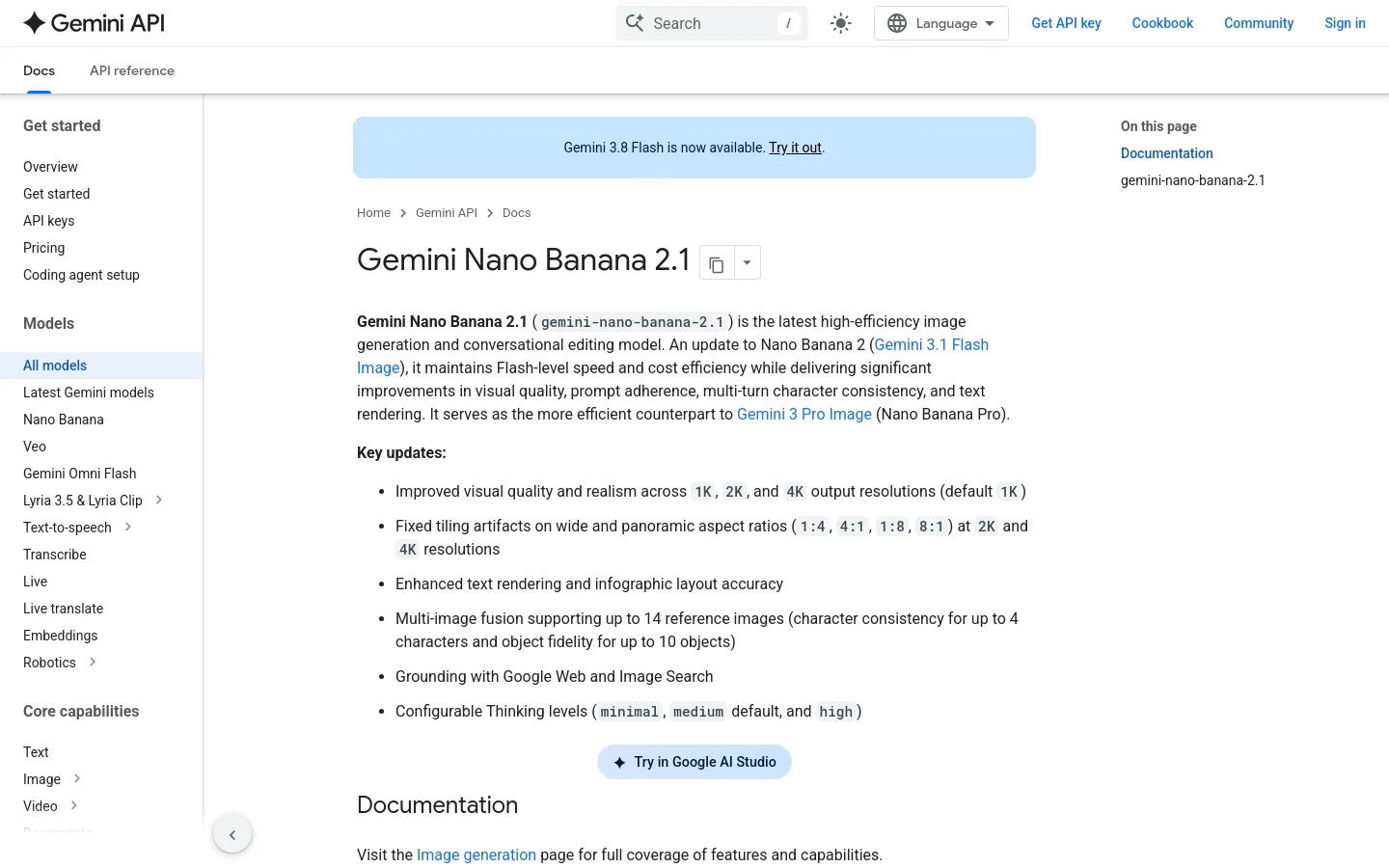
Nano Banana 2.1 is Google’s image generation and conversational editing model, available as gemini-nano-banana-2.1 in the Gemini API. It supports 1K, 2K and 4K images, multi-image references, and Google Web and Image Search grounding. Google released it to general availability on October 6, 2026.
Official source 1 ↗ · Official source 2 ↗Features
- Generate and refine images. Create images and refine them through conversational editing with the gemini-nano-banana-2.1 model. Official source 1 ↗
- Choose resolution and panoramic formats. Generate 1K, 2K or 4K images, with 1K as the default. Google reports fixes for tiling artifacts in 1:4, 4:1, 1:8 and 8:1 formats at 2K and 4K. Official source 1 ↗
- Combine reference images. Use up to 14 reference images. Google specifies character consistency for up to four characters and object fidelity for up to ten objects. Official source 1 ↗
- Create text-heavy visuals. Google reports improved text rendering and infographic layout accuracy. Posters and diagrams are among its stated use cases. Official source 1 ↗ · Official source 2 ↗
- Ground images in search. Use Google Web and Image Search grounding to bring search context into image generation. Official source 1 ↗
- Adjust thinking. Select minimal, medium or high thinking; medium is the default. Official source 1 ↗
Pricing & free limits
Image output is $30 per million tokens. Input costs $1.50 per million tokens; text and thinking output costs $7.50 per million tokens. These token charges are separate from the image output amounts. Official source 1 ↗
Image output is $15 per million tokens. Input costs $0.75 per million tokens; text and thinking output costs $3.75 per million tokens. The model supports Batch API. Official source 1 ↗ · Official source 2 ↗
Billing details
Google Web and Image Search grounding includes 5,000 search requests per month shared across Gemini 3.x models, then costs $14 per 1,000 requests. One model request can run multiple billable search queries. Official source 1 ↗
For paid Gemini API use, Google says prompts and responses are not used to improve its products. Prompts and responses may still be logged for a limited period for abuse prevention and required legal or regulatory disclosures. Official source 1 ↗
Free access & limits
Google lists the model’s Standard and Batch API free tiers as unavailable. The page’s Google AI Studio trial link does not establish a recurring free image allowance for this model. Official source 1 ↗ · Official source 2 ↗
Best for & limitations
Iterate on an image through several rounds of conversational edits. Official source 1 ↗ · Official source 2 ↗
Draft posters, diagrams and localized text visuals, then check the rendered wording and small text. Official source 1 ↗
Combine reference images for scenes involving recurring characters or products, while checking consistency in the result. Official source 1 ↗ · Official source 2 ↗
- Small text and long copy can degrade. Google reports poor rendering of small text, long paragraphs and page-length text; small text is often blurry at 1K. Official source 1 ↗
- References do not guarantee consistency. Characters may differ between reference images and the output. An edit can also retain the subject’s original pose. Official source 1 ↗
- Localized edits may miss instructions. Mask- or doodle-based edits may only partly follow instructions or leave ink marks. Left/right spatial placement can also be confused. Official source 1 ↗
- Check facts and allow for failed requests. Google lists hallucinations, limits in factuality and 3D reasoning, and occasional slowness or timeouts. Official source 1 ↗